On August 28, the Summer Universities of the Economy of Tomorrow inaugurated a new event dedicated to a major issue facing our society: the University of Tomorrow’s Food.
France’s food sector plays an essential role in the national economy. It accounts for nearly 15% of GDP, or €358 billion, and nearly 3 million jobs. But beyond its economic weight, food is now at the crossroads of several major issues: public health, the environment, agriculture and food sovereignty.
As the only public certification prohibiting the use of synthetic chemical pesticides, organic farming seeks to address these challenges through a comprehensive approach, based in particular on the “One Health” principle, which considers human health, animal health and the health of ecosystems to be closely interconnected.
On the occasion of this first University of Tomorrow’s Food, La Maison de la Bio, in partnership with the Mouvement Impact France, placed a key question at the heart of the discussions: “Does public health need more organic food?”
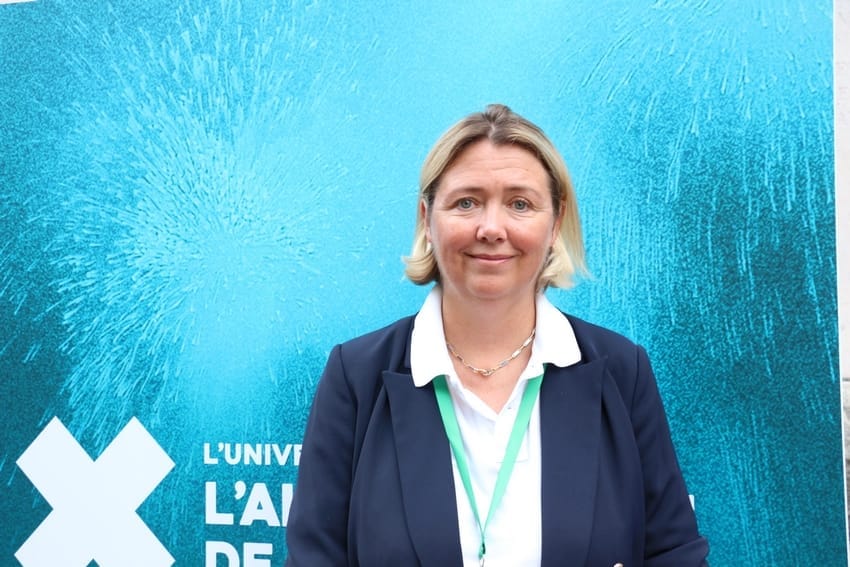
Following this roundtable discussion, Airs de Paris met with Christelle Le Hir, co-chair of La Maison de la Bio and chair of the executive board of La Vie Claire.
Meeting with
Christelle Le Hir
What is your vision of tomorrow’s food system?
My vision is quite clear: we need to reach at least 12% organic food consumption, compared with around 6% today.
We are increasingly making the connection between our health and our diet. For us, organic farming is one of the important responses to this issue: fewer pesticides, less ultra-processing and a diet that places greater emphasis on product quality.
I am convinced that the future of food will be organic. This is precisely why we are committed to this cause with La Maison de la Bio.
How can we concretely support the production and consumption of organic products in France?
Even before talking about consumption, we need to talk about production. We must first protect and support French organic production.
To achieve this, the government must support producers, particularly through national subsidies, but also through European policies. This is a priority.
We must then meet the existing consumption targets, particularly within the framework of the SNANC in France. It sets targets for the consumption of organic products, both for consumers and for collective catering, commercial catering and, in particular, school canteens.
The government’s role is therefore also to legislate and ensure that these targets are met. We need to enable local authorities to reach a minimum of 20% organic products, with targets adapted according to product categories.
Ultimately, public authorities have an essential role to play. This requires genuine political mobilization, but also the implementation of laws and mechanisms to ensure that the targets set are met and to sustainably support the French organic sector.
What place should French and European organic farming occupy in the global market?
Organic farming is also European, since all organic products grown in Europe comply with the same set of specifications. We already have a great deal of work to do at both the French and European levels.
Today, only around 6% of food consumption is organic. I would say that when we reach 50% organic consumption in France and Europe, we can go to China, Japan or other countries and try to further develop the consumption of organic products.
But before having a truly global vision, we already have an enormous amount to do here, in France and Europe.
The development of organic farming is complex, particularly because it involves constraints and compliance with precise specifications. It is also production that remains somewhat more expensive than conventional farming.
We therefore need to start by focusing on the national and European markets before considering a truly global dimension.
For our part, we are above all committed to French organic farming and we favor local production, with as few imports as possible from the rest of the world.
The objective is therefore first to build a strong, accessible and sustainable French organic sector before seeking to develop it further internationally.
Making organic food more accessible
This first University of Tomorrow’s Food opened up an essential discussion on the role that organic food should play in public policy and in our eating habits. An ambition is emerging: to make organic products more accessible and increase their consumption, while strengthening French and European production capable of sustainably meeting this demand.
For La Maison de la Bio, the challenge is to make organic farming a genuine lever for transforming the food system, by taking a coherent approach to health, environmental protection, changes in agricultural practices and consumption patterns.
Beyond figures and market shares, the question ultimately concerns a genuine choice for society: what kind of food do we want for tomorrow, and what kind of agriculture are we prepared to support in order to produce it?
Making organic food more accessible therefore also means thinking about how we want to produce, consume and pass on our food model to future generations.
Interview: Wendy
Written by: Hervé
Photo: Charles
Magazine Digital
Airs de Paris : 2026 Autumn & winter :
https://airsdeparis.com/a-la-une/airs-de-paris-2026-autumn-winter/

Fashion 2026 – Autumn & winter :
https://airsdeparis.com/publication/airs-de-paris-fashion-2026-autumn-winter/

Kiosque
Print Magazine :
https://www.journaux.fr/produits/presse/F%C3%A9minin-6/Airs-de-Paris-280044
Abonnement :
https://www.uni-presse.fr/abonnement/abonnement-magazine-airs-de-paris/