
A gentle pause away from performance at all costs, where the body regenerates and the mind finds calm.
Tai Chi Chanrou® offers a new vision of movement: conscious, fluid, and deeply revitalizing.
Created by Master Zhang Bin, this contemporary method transforms gesture into true meditation in action, where each movement becomes an experience of presence, attentive listening, and inner renewal.
The term Zen originates from the Sanskrit Dhyāna, referring to meditation and deep mental concentration. Soft evokes gentleness, flexibility, and respect for the body.
Within the philosophy of Tai Chi Chanrou®, these two dimensions naturally intertwine. The mind settles as the body unfolds, and movement becomes a space of unity between inner awareness and physical expression.
Each gesture is slow, precise, and fully embodied. There is no forcing, only sensing. Listening. Being fully present.
A Method Nourished by Ancient Wisdom
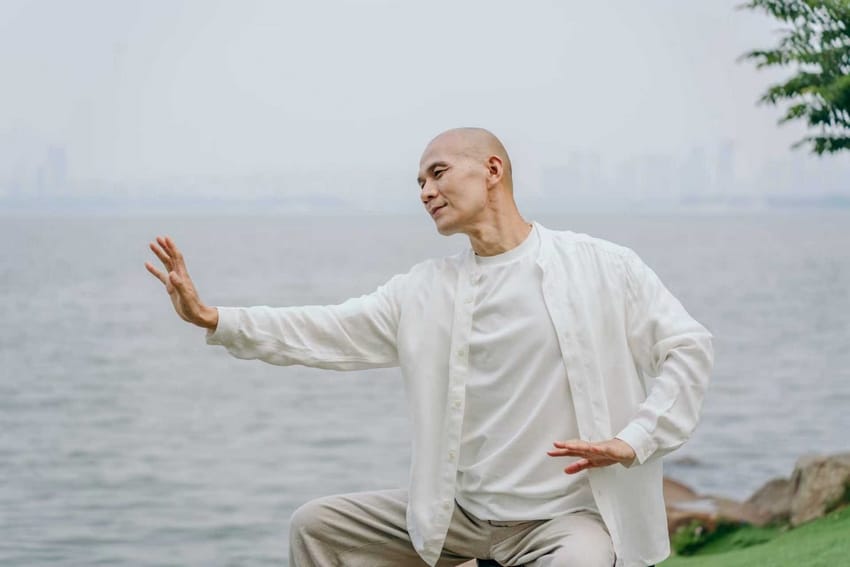
Tai Chi Chanrou® is an innovative approach to conscious movement, positioned at the crossroads of Eastern traditions, movement sciences, and contemporary well-being practices.
The creator of the Tai Chi Chanrou® system, Master Zhang Bin, draws upon the Taoist tradition of Zhao Bao Tai Chi, enriched by influences from yoga, Pilates, dance, swimming, and gentle gymnastics.
The method is based on eight types of three-dimensional movements involving the spine and limbs.
Through practice, the spine becomes as supple and alive as a dragon in motion, both stable and flexible, grounded yet fluid.
The shoulders and hips regain their natural mobility, free from tension and pain. Meridian circulation improves, Qi harmonizes, and blood flows freely. The body reconnects with its original intelligence.
At the heart of the method lies the pelvis, regarded as the fundamental source of vital energy.
Movements originate in the spine, the true axis transmitting energy between the body’s center and the limbs. Gestures follow spiral trajectories, supported by a specific breathing technique known as Original Energy Breathing, or Yuan Qi.
Energy anchors into the earth, rises through the spine, and expresses itself as a fluid, spiral force that is both gentle and powerful. This dynamic enhances precision of movement while offering remarkable therapeutic and rehabilitative benefits.
An Invitation to Self-Awareness
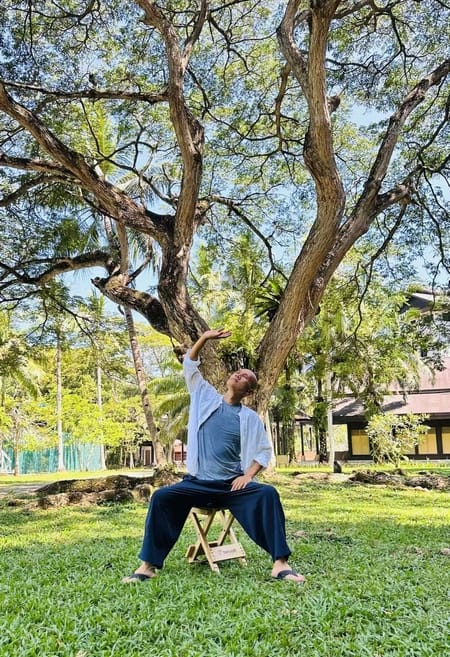
Tai Chi Chanrou® is far more than a practice. It is a profound invitation to listen inwardly.
By guiding breath and movement into continuous harmony, this discipline reconnects us with an energy that is sustainable, stable, and serene.
Practice becomes an intimate and joyful exploration, a pathway toward restored balance.
Accessible to all, with no prior experience required, Tai Chi Chanrou® offers the keys to cultivating deep grounding and inner peace, inspiring a more fulfilled and harmonious daily life.
To deepen your understanding, we invite you to read the interview Master Zhang Bin gave to Airs de Paris.
Why Is the Pelvis at the Center of Movement?
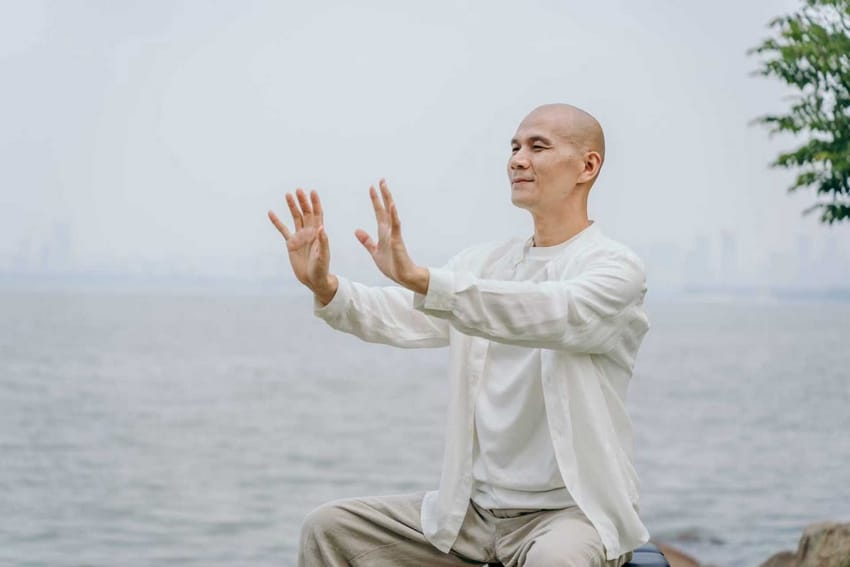
The pelvis is the fundamental center of the human body, comparable to the hub of a wheel, with the arms and legs acting as its spokes.
In every Tai Chi Chanrou® movement, action must originate in the pelvis in order to transmit energy efficiently toward the extremities.
When movement begins at the level of the pelvis, energy develops progressively, much like the motion of a whip. A subtle impulse at the base transforms into power at the tip.
Because the pelvis lies at the body’s center, energy has time to organize, intensify, and spread harmoniously throughout the entire structure.
This awareness fosters a practice that is more fluid, more efficient, and more coherent. Energy anchors in the Dan Tian, intention guides the breath, and breath generates force.
Inner and outer dimensions unite. Suppleness meets strength. Stability balances mobility.
Body, mind, intention, energy, and spirit merge into a single, unified experience.
What Is the Original Qi Breathing Method (元气呼吸法)?
Inspired by Zhao Bao–style Tai Chi Chuan, this Taoist breathing technique is designed to cultivate and strengthen original vital energy, known as Yuan Qi. Human life is sustained by breath, and preserving and regenerating this primordial energy is considered the foundation of lasting health and longevity.
Most adults rely on shallow, chest-based breathing, a limited pattern that prevents the full assimilation and storage of Qi present in the air. The Original Qi Breathing method offers a conscious internal pathway instead.
Through visualization, practitioners guide inhaled energy from the nostrils to the Baihui point at the crown of the head, then down along the spine to the Mingmen point in the lower back, regarded as the reservoir of innate energy. This process teaches how to accumulate, preserve, and nourish vital force.
With regular practice, this breathing method generates a sense of energetic fullness, renewed physical vitality, and deep mental and spiritual balance.
When combined with the soft, continuous, and fluid movements of Tai Chi Chanrou®, this breathing activates an internal circulation that gently warms the lower abdomen, the Dan Tian. This warmth then radiates throughout the limbs, creating a profound state of well-being and inner harmony.
On a physical level, the method mobilizes the entire body. It stimulates the nervous system, stretches and tones muscles and fascia, softens the joints, and enhances overall flexibility. It improves cardiopulmonary capacity, increases muscular strength and endurance, and promotes the circulation of energy through the meridians. Metabolism is optimized, coordination refined, and the body is better prepared to meet both daily challenges and athletic practice with ease and lightness.
By uniting movement and breath, this method opens the path to renewed vitality, where body and energy become one.
What Is Three-Dimensional Spiral Movement of the Spine and Limbs?
From an anatomical perspective, the knee and elbow function as hinge joints, allowing linear movement with a single degree of freedom. In contrast, joints such as the hips and shoulders allow multidirectional and rotational mobility. The combination of these linear and circular movements generates the spiral, a fundamental pattern found in both dance and Tai Chi.
A similar principle governs the spine, where hinge and rotational mechanisms alternate. From bottom to top, the sacroiliac joint allows limited hinge-like movement; the lumbosacral junction introduces rotation; the lumbar vertebrae function primarily as hinges; the lower thoracic vertebrae allow rotation; the mid-thoracic vertebrae return to hinge movement; the cervical vertebrae enable rotation; and finally, the joint between the occiput and the atlas once again functions as a hinge.
This alternating structure enables the spine, like the limbs, to generate spiral movements that are both efficient and harmonious.
Engaging this spiral force, at once graceful and powerful, allows movement to unfold with greater ease and effectiveness, significantly amplifying the benefits of the practice.
French Version :
https://www.airsdeparis.fr/art-de-vivre/tai-chi-chanrou-le-mouvement-comme-meditation/
Video:
Magazine digital
2025 – Automne et hiver

https://www.airsdeparis.fr/publication/airs-de-paris-2025-summer/
2025- Fashion Automne et hiver


