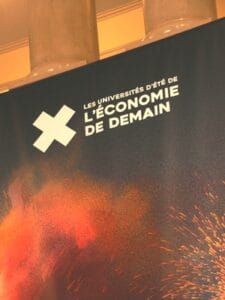
On Friday, August 28, the Cité internationale universitaire de Paris hosted the eighth edition of the Summer Universities of the Economy of Tomorrow.
Organized by the Mouvement Impact France, the event brought together entrepreneurs, business leaders, political representatives and civil society stakeholders around the same question: how can France and Europe strengthen their economic independence without abandoning social and environmental requirements?
“Independence Day”: behind this deliberately evocative title, discussions focused largely on economic and European sovereignty.
In a world marked by geopolitical tensions, industrial dependencies, resource scarcity and the accelerating pace of climate change, one question arises: how can we regain the capacity to choose and act?
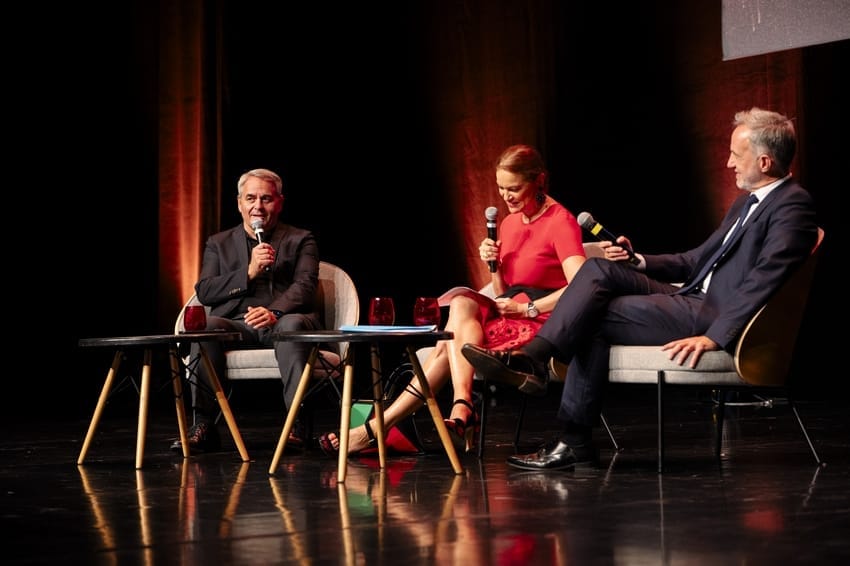
Throughout the day, this notion of independence was addressed from different angles: industry, energy, food, finance and territories. The discussions showed just how closely interconnected these issues have now become.
Behind the question of sovereignty lies another question, that of tomorrow’s economic model: how can we create value while reducing our dependence on external resources and supply chains?
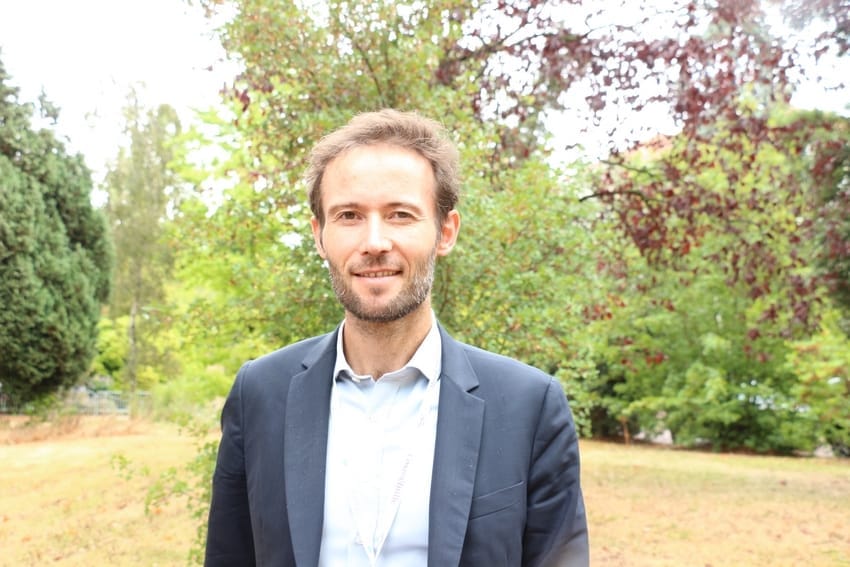
On this occasion, Airs de Paris met with Baptiste Perrissin-Fabert, Deputy Managing Director of ADEME.
Interview with
Baptiste Perrissin-Fabert
In your view, what should tomorrow’s economy look like in the face of the challenges of the ecological transition, competitiveness and sovereignty?
It is a broad subject. But for us, it is first and foremost about the economy as a whole. There cannot be, on the one hand, a “green” economy and, on the other, an economy that operates according to different principles. Today, the challenges of competitiveness and sovereignty are closely linked to those of the ecological transition.
I also believe that this is precisely the meaning of the theme of this day, “Independence Day”. We are facing increasingly severe constraints on resources. In this context, the ecological transition is not only an environmental necessity: it is also an opportunity to rethink our economic model and strengthen our autonomy.
It is precisely through this transition that we will be able to build tomorrow’s economy. That is why, for us, the functionality and cooperation economy plays a central role.
This model also makes it possible to strengthen our independence from resource imports, by seeking to preserve as much as possible the resources available in our territories and to derive as much value from them as possible.
The challenge, ultimately, is to achieve this famous decoupling between value creation and resource consumption, even as resources become increasingly scarce and constrained.
In other words, it is no longer simply a matter of producing more with less, but of producing differently, creating more value from the resources we already have and building an economy that is more resilient, more cooperative and more independent.
Is local production a solution?
Not all production can be local. We need international cooperation, and there are also pieces of equipment that we no longer manufacture in France. We therefore need to develop cooperation with Asian countries, particularly China.
However, once the materials and equipment arrive on European territory, we need to ensure that their use and value are maximized. This means that we genuinely need to shift towards a circular economy.
Once these resources are here, we need to preserve them and maximize their value. The aim is to avoid sending them elsewhere only to then re-import the same materials, or equipment made from them. That would mean a loss of value and a genuine waste of resources.
Of course, we will never be completely self-sufficient. We need international trade and partnerships with Asian countries, particularly to exchange technologies and expertise in both directions.
But once the materials and equipment are present on our territory, we must be able to keep them within our value chains for as long as possible.
This is where the circular economy takes on its full meaning: maximizing the lifespan of products, reuse, repair and recycling in order to preserve the value of resources as much as possible.
Otherwise, we are simply moving resources around without extracting all the value possible from them and, ultimately, this is waste.
Do you currently see the presence of Chinese industrial companies in Europe as an opportunity to accelerate the development of European technology?
Today, there is a real interest in cooperating, particularly by encouraging Chinese industrial companies to establish themselves in Europe.
We have much to learn from certain technologies that are now highly advanced in China, just as we were able in the past to share our expertise and technologies.
Of course, the challenge is to maximize value creation on European territory. But this would also enable us to incorporate European standards and regulations directly into these products.
For us, therefore, this is a particularly promising avenue.
Faced with the challenges the world is confronting today, do we need global governance to better manage resources and address common challenges?
Perhaps it is even a necessity.
Today, when we see disasters spreading around the world, we can see that, even though countries are separated by borders, territories and ecosystems themselves are deeply interconnected.
Multilateralism is facing certain difficulties today. But this global governance already exists, notably through conferences organized under the auspices of the United Nations, whether on climate, biodiversity or the fight against soil desertification.
This governance therefore does indeed exist, even if it is currently being challenged. I think that, in any case, Europe plays a driving role in keeping it alive and maintaining this dynamic of international cooperation.
In any case, this will be one of Europe’s positions: to continue to keep this international governance alive. We must indeed manage global public goods, resources and common goods that concern us all.
And one thing is certain: if we fail to coordinate, we risk wasting these resources and worsening, or even accelerating, the difficulties we are already facing.
What is ADEME’s priority?
We are a government agency, with very clear objectives, particularly when it comes to decarbonization.
Our role is to be the operator that enables France to accelerate its trajectory towards carbon neutrality.
We also have objectives in terms of the circular economy, with the ambition of decoupling resource consumption from value creation. We also work on adaptation to climate change.
We are therefore active across all these areas. But today, our priority is very clearly the decarbonization of industry.
Because beyond the climate issue, decarbonization has become a major issue of competitiveness and sovereignty for our country.
What are the main challenges today in relocating textile production to France?
In the textile sector, we are currently trying to rebuild production capacity in France.
It is a real challenge, because we have lost a large part of our expertise and industrial infrastructure over the years. It is undoubtedly also through new business models that we will succeed in relocating certain production activities to France.
Then, organizations such as Business France play an important role by acting as a link between foreign countries and France. In particular, they can support entrepreneurs in their development and help them better understand European regulations.
Interview : Wendy
Written by : Hervé
Photo : Charles
Magazine Digital
Airs de Paris : 2026 Autumn & winter :
https://airsdeparis.com/a-la-une/airs-de-paris-2026-autumn-winter/

Fashion 2026 – Autumn & winter :
https://airsdeparis.com/publication/airs-de-paris-fashion-2026-autumn-winter/

Kiosque
Print Magazine :
https://www.journaux.fr/produits/presse/F%C3%A9minin-6/Airs-de-Paris-280044
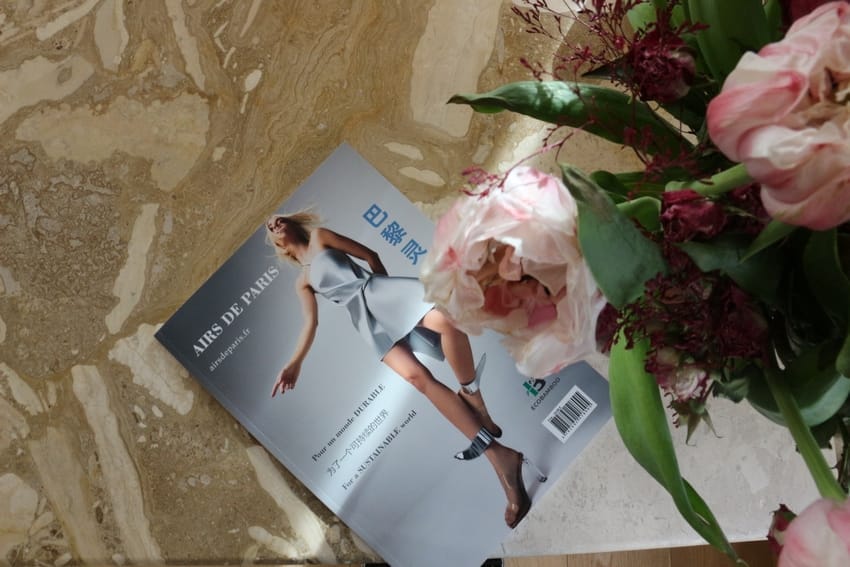
Abonnement :
https://www.uni-presse.fr/abonnement/abonnement-magazine-airs-de-paris/