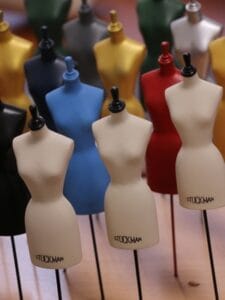
The making of Stockman mannequins embodies what might be called the wisdom of the hand. Like art and haute couture, it speaks an original language rooted in gesture.
Patient, precise, and intuitive, the hand transforms raw material into form, and form into expression. This inherited knowledge, drawn from tradition yet continuously reinterpreted, holds a quiet power. It connects the intelligence of gesture to the perception of beauty.
In an era shaped by industrial production and digital processes, such craftsmanship acquires renewed significance. It reminds us that true artisanal value lies not in replication, but in interpretation. Where machines reproduce, the hand understands and, in doing so, gives meaning.
Craftsmanship in Dialogue
At Art Capital, this alchemy of craft took shape in a rare dialogue between painting and haute couture.
Two one of a kind dresses were presented as works of art, objects that move beyond fashion to occupy a space between disciplines, cultures, and sensibilities.
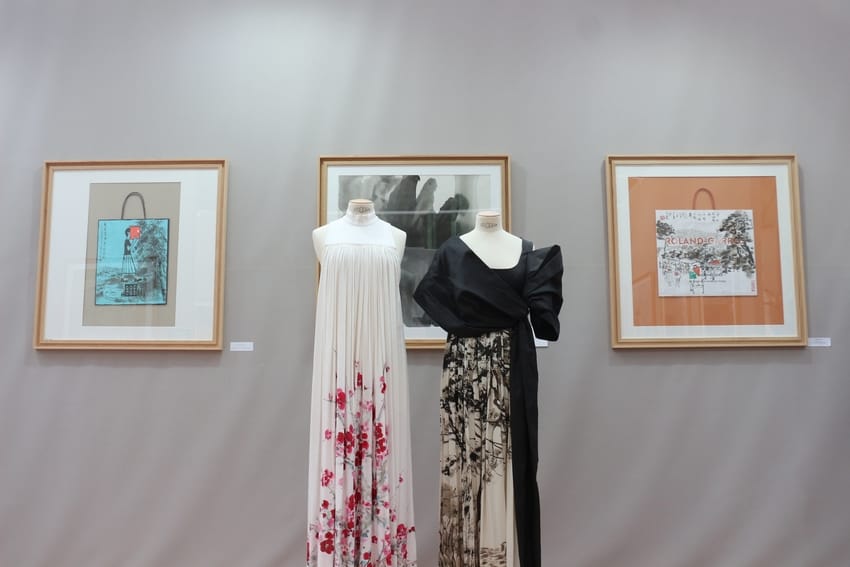
The floral motifs were hand painted by Wang Ying, Deputy Permanent Delegate of China to UNESCO. Each bloom appears to emerge organically from the fabric, merging pictorial delicacy with poetic symbolism and transforming the textile into a narrative surface.
The fabrics, developed from next generation eco conscious bamboo fibers, lend the garments an airy lightness, a fluid softness, and structural resilience, anchoring them within a contemporary and responsible design approach.
The silhouettes were conceived by Imane Ayissi, whose work is defined by a sculptural sensibility and an ongoing dialogue between African heritage and Parisian elegance. His constructions do not constrain the artwork. Rather, they frame it and allow the imagery to breathe.
Here, textile becomes architecture, and cut becomes a form of setting. Together, they establish a precise balance between structure and surface. These garments no longer function simply as clothing, but as points of connection between art and fashion, tradition and modernity, East and West.
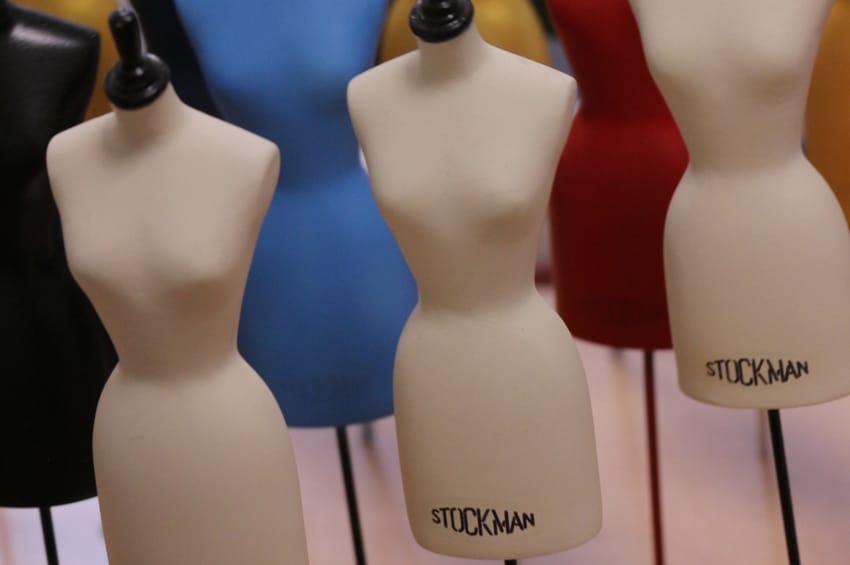
Presented on Stockman mannequins, long standing icons of Parisian couture ateliers, the works take on an almost museological presence. Removed from the movement of the body, the silhouettes appear suspended in time, as if the essence of the creative gesture had been held in place.
Over a Century of Craft
For more than a century, Stockman mannequins have accompanied the most influential fashion houses. Silent yet essential, they have supported the construction of collections and the evolution of form within haute couture.
On these forms, every detail becomes visible: the line of a stitch, the tension of a fabric, the rhythm of a drape.
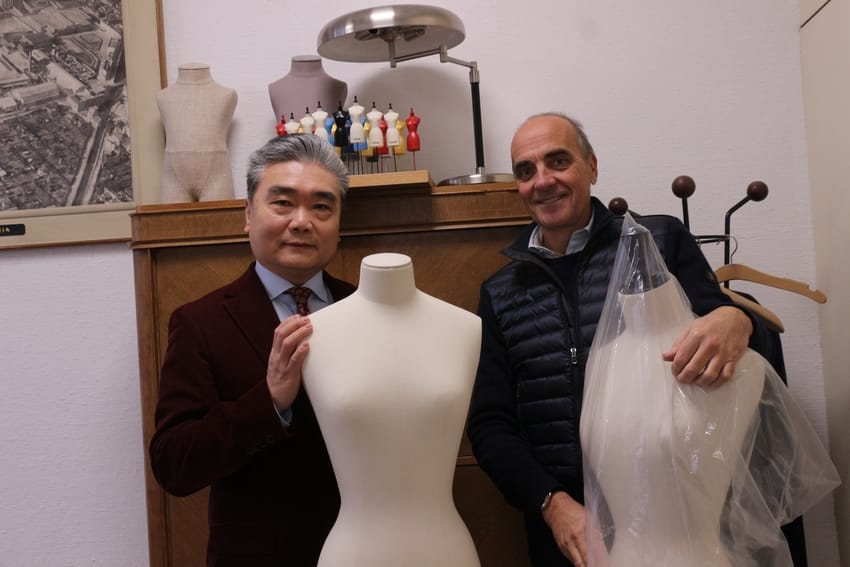
To better understand this singular craft, Wang Ying met with Louis-Michel Deck, CEO of Stockman, and entered the workshop. This immersion revealed not only the precision of the process, but the continuity of a knowledge transmitted through time.
In this space, craftsmanship is not simply a technique—it is a language, carried by the hand, and sustained across generations.
How is a Stockman mannequin made?
Each Stockman mannequin is the result of more than 160 years of preserved artisanal knowledge. Behind every piece lies a precise sequence of gestures, refined over time, transmitted across generations, and guided by an uncompromising standard of quality.
The process begins with carefully prepared recycled papier mâché. Both lightweight and remarkably durable, it forms the internal structure of the mannequin. Applied entirely by hand onto molds representing different body types, including women, men, and children, it allows for a faithful rendering of human volume and proportion.
Once layered, the form is placed in a kiln for approximately ten hours. This crucial stage defines its stability and structural integrity. After drying, the mold is removed, and the surface is meticulously hand sanded, transforming a raw structure into a smooth, even form that is ready to be worked upon.
The dressing stage is fundamental. A layer of padding is first applied, providing both softness and resistance for pinning. It is then covered with carefully stretched fabric, adjusted with precision. The surface must remain perfectly balanced, free from wrinkles or tension, offering designers an ideal working interface.
The base is reinforced with a wooden support to ensure stability, while a metal stand, either fixed or adjustable, is added according to use. Designed for the demands of the atelier, the mannequin must remain reliable under constant handling.
The final gesture lies in the markings at the neck and waist. More than technical references, they function as a signature, the DNA of Stockman, affirming each piece as the product of exceptional craftsmanship.
Did Christian Dior design the mannequin himself?
According to legend, he did. The story refers to the B306 model, developed in 1947 for Dior’s “New Look” collection.
In the post-war period, Christian Dior redefined the female silhouette—introducing cinched waists and amplified volume. It is said that he contributed to the design of this mannequin so that garments could precisely follow these new proportions.
The entire collection was developed on Stockman mannequins, anchoring their place within the history of haute couture and contributing to their enduring international recognition.
And when you receive a special order from a major fashion house?
We begin with the mold closest to the client’s measurements, then refine the proportions by adjusting the bust, waist, and hips with precision.
A prototype is developed and submitted for approval. From there, feedback is integrated, and further adjustments are made if necessary before the final covering is completed.
At that point, the mannequin is no longer a tool. It becomes a “second skin,” tailored to a specific body, a collection, or even a creative vision.
Can such an ancient process be modernized?
Not entirely.
The application of papier mâché depends on gesture and physical intuition. Each piece carries subtle variations, shaped by the hand that forms it. To maintain this level of quality, most stages must remain manual.
That said, technology does play a role. 3D tools are used to develop new molds and body types, supporting innovation upstream.
Here, technology does not replace craftsmanship. It supports it. The essence of production remains resolutely artisanal.
What is your annual mannequin production?
Over 30,000 pieces.
Despite this scale, each mannequin passes through multiple hands. Every stage requires specific expertise, and nothing is left to automation alone.
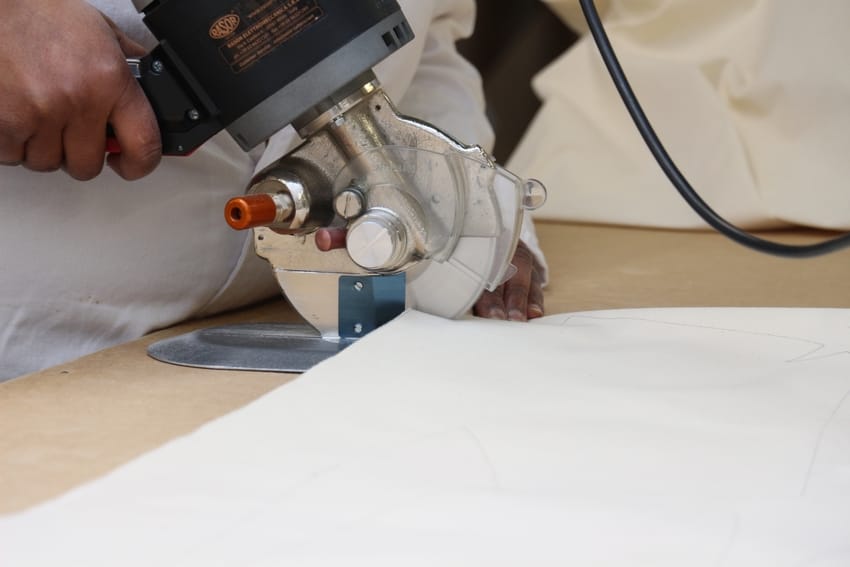
Seams must align with absolute precision, as designers rely on these structural lines to construct garments. In certain stages, laser tools are used to ensure the center line is perfectly positioned.
What truly distinguishes your work from industrial production?
Sensitivity to detail.
Machines can replicate form, but they cannot perceive nuance. A trained eye, on the other hand, can detect the slightest imbalance and correct it instantly.
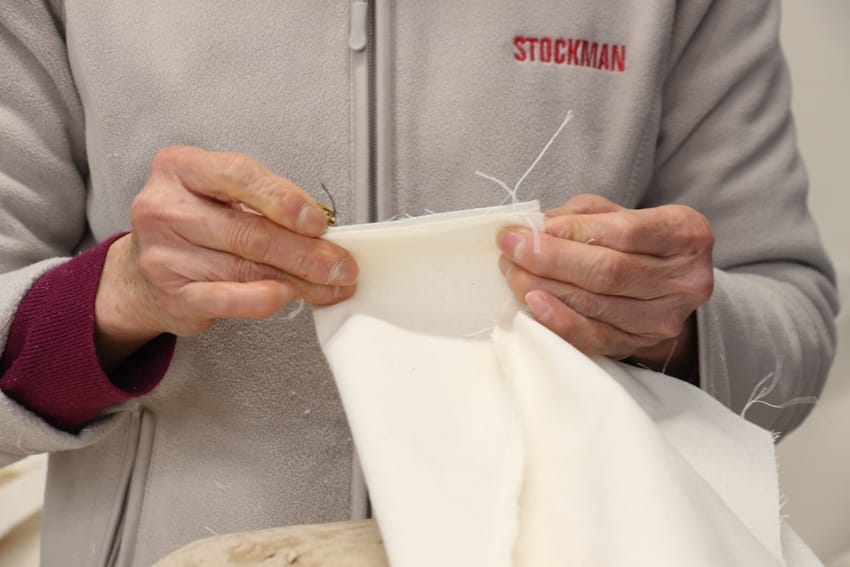
Many of our craftsmen have been here for decades. One of our seamstresses has worked in the workshop for 38 years. She relies on her eye and her hand alone to achieve a flawless finish.
This kind of precision is not programmed. It is acquired over time.
How many molds do you have?
More than 200, all made of plaster.
Each body shape requires its own method of application. This technique was developed here over a century ago and continues to be transmitted, unchanged in its fundamentals.
And what about the textile covering?
For over forty years, we have used raw canvas produced exclusively in France. Over the past eight years, it has been entirely made from 100% organic cotton.
Each piece of fabric is cut according to precise patterns, then applied over a layer of padding to achieve the ideal balance of grip, flexibility, and resistance for pinning.
What is your priority today?
To preserve the Stockman spirit.
Our clients demand an exceptional level of precision, which requires rigorous control at every stage of production. The objective is not perfection as an abstraction, but consistency at the highest level.
Behind every mannequin lies a sequence of exact gestures, rooted in the past and continuously practiced in the present.
French Version:
https://www.airsdeparis.fr/design/stockman-sagesse-de-la-main/
Magazine Digital
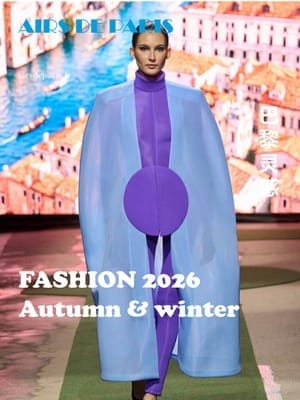
Airs de Paris : 2026 Autumn & winter :
https://airsdeparis.com/a-la-une/airs-de-paris-2026-autumn-winter/
Fashion 2026 – Autumn & winter :
https://airsdeparis.com/publication/airs-de-paris-fashion-2026-autumn-winter/
Kiosque
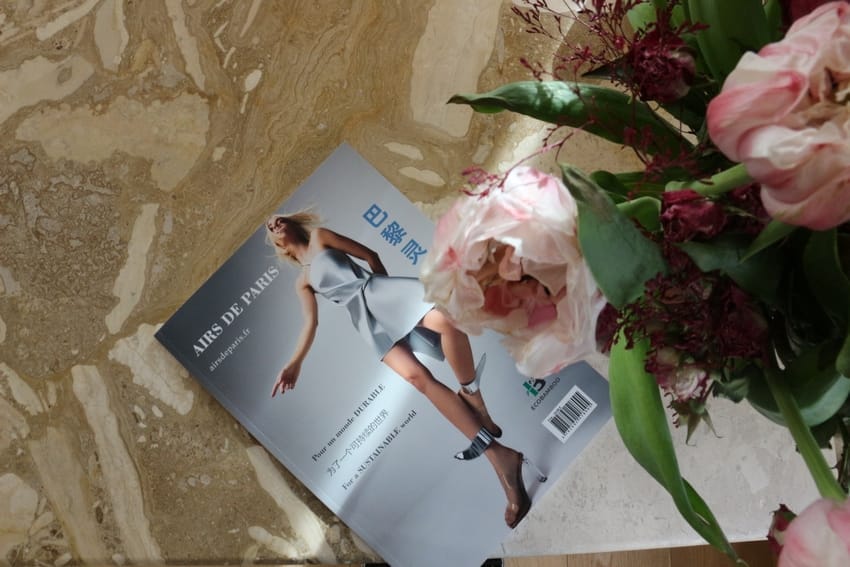
Print Magazine :
https://www.journaux.fr/produits/presse/F%C3%A9minin-6/Airs-de-Paris-280044
Abonnement :
https://www.uni-presse.fr/abonnement/abonnement-magazine-airs-de-paris/