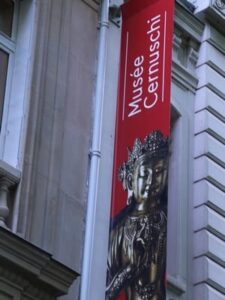
The Cernuschi Museum is a true invitation to travel through the civilizations of East Asia, housed within an elegant and intimate architectural setting.
Combining historical richness, contemporary exhibition design and a vibrant cultural programme, it has established itself as one of Paris’s essential destinations for discovering Asian art and culture.
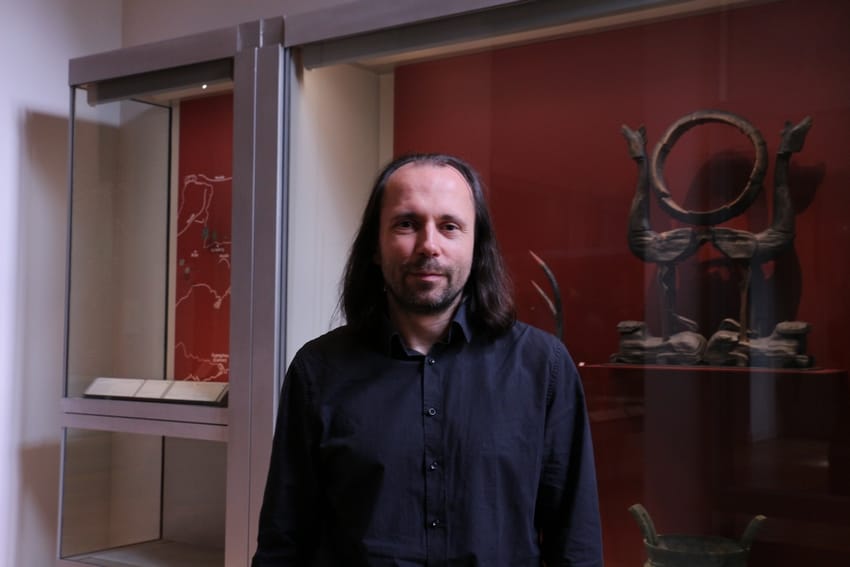
Airs de Paris had the privilege of meeting Mael Bellec, Curator of Chinese and Korean Art, who shared with us the fascinating stories behind this unique institution, nestled in the heart of the French capital.
An Interview with
Mael Bellec
Could you tell us more about the Cernuschi Museum?
The Cernuschi Museum, located just a short distance from Parc Monceau in Paris, is now one of France’s major museums of Asian art. But before becoming a museum, this building was the private residence of a man with an extraordinary life story: Henri Cernuschi.
Henri Cernuschi was an Italian-born financier, collector and intellectual. Politically engaged, he was forced to leave Italy in the early 1850s because of his republican views. He settled in France, where he made his fortune in business. Deeply involved in French political life, he adopted left-wing positions, which once again brought him into difficulties, particularly during the Paris Commune of 1871. Too bourgeois for the Communards, yet too progressive for the Versailles government, he found himself politically isolated.
Seeking to distance himself from this turbulent environment, Henri Cernuschi embarked on an extensive journey around the world between 1871 and 1873. His travels took him first to England and then the United States, before continuing to Japan, China, Indonesia, Sri Lanka and India, and eventually back to France.
During this journey, he acquired around 5,000 works of art, primarily bronzes, ceramics, sculptures and paintings from East Asia. It was during this period that the idea of creating a major collection truly took shape.
Upon returning to Paris, he pursued two major projects. First, he organized a large exhibition at the Palais de l’Industrie in 1873 to present his Asian discoveries to the public. At the same time, he commissioned the construction of a private mansion on a plot of land he had recently acquired in Paris. Designed as his main residence, the building was also conceived to house his collection.
The house was spacious and filled with light, drawing inspiration from the architecture of Italian palaces. Cernuschi displayed his works throughout the various rooms, particularly in the large central hall, where his Asian bronzes were exhibited almost wall to wall.
Although he travelled through several countries in Southeast Asia, his collection focused primarily on Chinese and Japanese art. India and Sri Lanka, for example, featured in his travels but are only sparsely represented among his acquisitions.
When Henri Cernuschi died in 1896, he bequeathed his house and entire collection to the City of Paris. Two years later, in 1898, the Cernuschi Museum officially opened its doors to the public.
How does the Cernuschi Museum differ from the Guimet Museum in its approach to Asian art?
It is important to remember that in Henri Cernuschi’s time, the Guimet Museum was not yet a museum dedicated to Asian art. Originally, it was actually a museum of the history of religions, which certainly contained numerous Chinese and Japanese objects, but whose primary mission was not specifically devoted to the arts of Asia.
It was not until 1945 that the Guimet Museum officially became a national museum of Asian arts, marking a major turning point in its mission. It was from that point onward that the question of the coexistence of two Asian art museums in Paris really began to arise.
However, the two institutions do not have quite the same objectives or geographical scope. The Guimet Museum covers a vast area, stretching from the Indian subcontinent and Afghanistan to Japan, including Central Asia. The Cernuschi Museum, by contrast, focuses primarily on East Asia, with a particular specialization in China, Korea, Japan and Vietnam. It also has a number of objects from other regions, but these four countries form the core of the collection.
Another difference lies in the way the two museums cover the history of Asian art. In 1946, the Cernuschi Museum organized an exhibition devoted to modern Chinese art. Since then, more than half of its activities — both exhibitions and acquisitions — have been devoted to modern and contemporary art, rather than exclusively to ancient art.
This may come as a surprise because the permanent collection follows a chronological sequence, beginning with the Neolithic period and extending to the 21st century. Ancient art therefore occupies a prominent place in the visitor experience.
The contemporary art section currently occupies a relatively small room, while ancient art benefits from a much larger exhibition space. As a result, visitors do not always realize just how central modern and contemporary art has been to the museum’s strategy for nearly 80 years.
Finally, even when the two museums cover the same periods — such as Chinese archaeology — their collections tend to be complementary. Where Guimet presents certain major works, Cernuschi offers others, often different but equally significant. For visitors interested in Asian art as a whole, the two institutions therefore provide distinct yet enriching perspectives.
And if you are particularly interested in modern and contemporary Asian art, the Cernuschi Museum is the place to explore.
How does the specialization of the Cernuschi Museum differ from that of the Guimet Museum?
The Cernuschi Museum is more specialized, in a sense. As I mentioned, at the Guimet Museum you will find a section devoted to Cambodia and another to India, whereas here, around 80% of the permanent collection is dedicated to China.
So although the Chinese section at Cernuschi may appear larger than the one at Guimet, this is mainly because most of our galleries are devoted almost exclusively to a single country, with some openings toward neighboring countries.
At the Guimet Museum, by contrast, the geographical area covered is much broader. Its Indian and Cambodian collections are particularly rich, and the museum therefore has to allocate space to these different regions.
Why did the Cernuschi Museum choose to organize its chronological display primarily around China?
The 2020 renovation reorganized the museum around a chronological presentation focused primarily on China. This approach reflects the importance and continuity of our Chinese collections compared with those of the other countries represented here.
For example, our Japanese collection focuses mainly on the Edo period, while around 90% of our Korean collection consists of modern and contemporary works. As for the Vietnamese collection, it contains many objects from the Bronze Age, but relatively few works from the millennium that followed.
China is therefore the only country for which our collections cover virtually every period continuously, from the Neolithic era to the present day. This is why we chose to structure the museum’s chronological presentation around Chinese history.
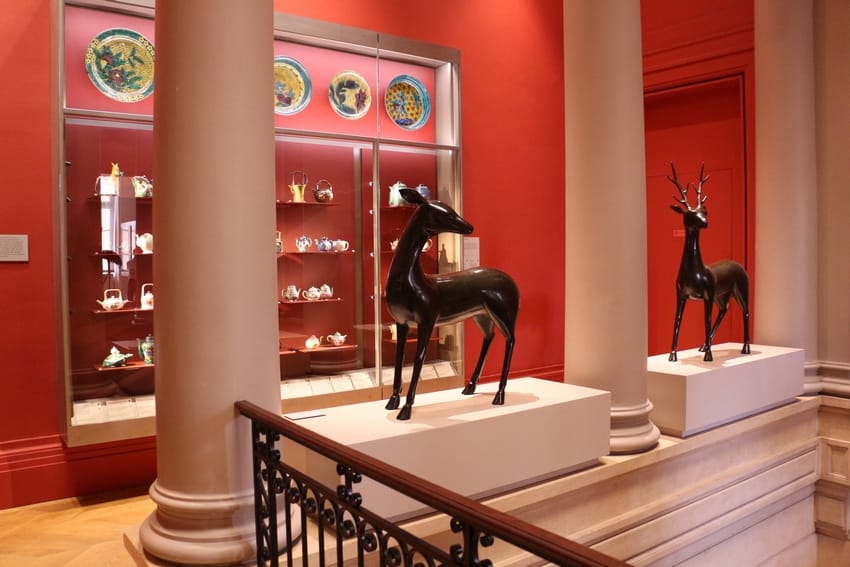
China is consequently present throughout the museum, while we regularly open windows onto neighboring countries whenever they are represented in our collections.For example, in the Bronze Age section, a display devoted to Vietnamese bronzes faces a display of Chinese objects from the same period.
The exhibition therefore follows a Chinese chronological thread, punctuated by insights into other Asian cultures according to the works available in our collections.At the heart of this presentation is a separate gallery devoted entirely to Buddhism. This mezzanine offers a chronology of Buddhist sculpture, featuring Chinese, Japanese and Korean works and thereby adding another dimension to the cultural diversity presented by the museum.
Why did Henri Cernuschi become particularly interested in collecting Chinese bronzes after initially beginning his collection in Japan?
The question of why Henri Cernuschi chose to build his collection around Asia is quite complex. Although Cernuschi wrote extensively during his lifetime, he left no text clearly explaining his motivations as a collector. We can therefore only formulate hypotheses.
We know that he was particularly interested in the history and material culture of foreign civilizations. For example, he carried out archaeological excavations in the Near East, demonstrating his interest in ancient history.
Why Bronze?
During his journey around the world, China and Japan were the first two Asian countries Henri Cernuschi visited after travelling through Great Britain and the United States. In Japan, he began collecting bronzes and ceramics on a large scale.
We cannot say for certain why he developed such a strong interest in these objects, but we know that he had previously taken an interest in metallurgy, particularly in the techniques used to mint coins. This may have developed a particular sensitivity to metalwork.
At the time, Japanese bronzes were still largely unknown in the West and represented a highly innovative artistic model. In France, the decorative arts were struggling to reinvent themselves, particularly in the aftermath of the Industrial Revolution, which had led to the mass production of objects that were often of lesser aesthetic quality. Many French artists and designers saw Japanese bronzes as a potential source of inspiration capable of revitalizing the decorative arts.
It is likely that Henri Cernuschi was receptive to this idea during his stay in Japan.
When he arrived in China, however, it was a genuine revelation. The Japanese bronzes he had collected were relatively recent, dating from the Edo period and therefore almost contemporary with his own time. In China, he discovered a bronze tradition of extraordinary antiquity, with works dating back to the second millennium BC.
He then set out to build a collection covering the history of Chinese bronze art, from the Shang dynasty through to the Zhou dynasty.
We can therefore assume that his project was carefully thought out and organized, judging from the coherence and richness of his collection. However, since he left no explicit writings explaining his intentions, this remains difficult to confirm with absolute certainty.
Where did most of the objects in Henri Cernuschi’s original collection come from?
Henri Cernuschi’s collection was primarily made up of objects acquired through the Asian art market. He would visit local dealers directly, and once they recognized him as a serious collector, some of them would even come to him with pieces to offer.
Most of his collection was therefore already in circulation at the time, which means that it was not, strictly speaking, an archaeological collection.
Objects discovered through archaeological excavations did later enter the museum’s collections, but this happened at a later stage, mainly during the first half of the 20th century.
The original collection, however, was primarily composed of objects purchased from Chinese and Japanese dealers.
What suggests that Henri Cernuschi already had a clear vision for his collection when he arrived in China?
It seems that Henri Cernuschi developed a structured approach to his collection quite quickly, certainly by the time he arrived in China.
This seems particularly clear because he did not remain in the country for very long, yet he managed to assemble a remarkably coherent and ambitious collection. It is therefore likely that he understood what he wanted to achieve from an early stage.
This can be seen in the types of objects he acquired. He purchased numerous bronzes, but he also collected old Chinese catalogues documenting these ancient objects.
Some of these catalogues had already been published in China many years earlier, and Cernuschi acquired them alongside the objects they described. In some cases, a bronze he purchased was actually illustrated in a catalogue he acquired at the same time.
This demonstrates a certain methodical approach and a genuine museum-oriented vision.
It is highly likely that he received advice from knowledgeable local dealers who understood the historical and artistic value of the pieces.
One of the few things we know for certain is that he complained at the time about the very high prices of Chinese objects, which were considerably more expensive than those he had found in Japan.
How has the Cernuschi Museum’s collection evolved from its creation to the present day?
The collection is extensive, although it does not encompass every existing work from the history of Chinese art.
Nevertheless, all the major periods are represented, with high-quality works from each era. It therefore provides an excellent introduction to the history of Chinese art.
The majority of our collection comes from Henri Cernuschi, who acquired his works from Asian dealers during the 19th century.
Later, during the first half of the 20th century, the museum was enriched by objects discovered through archaeological excavations. Other ancient works have continued to enter the collection, including in more recent years.
For example, in 2016, we were able to acquire several objects at auction from the former David-Weill collection, one of France’s great private collections.
But what truly transformed the character of the museum from the second half of the 20th century onward was our commitment to contemporary artists.
We began working directly with living artists, and these collaborations enabled us to expand the collection with modern and contemporary works. This marked an important turning point in the history of the museum.
Has the museum been renovated?
Yes. The museum had already undergone a renovation in 2005.
Between that date and 2020, the exhibition focused primarily on Chinese art from the Neolithic period through to the 12th century, which represented the majority of the collections on display.
During the 2020 renovation, we wanted to give greater space to the other countries of Asia and, above all, to extend the chronological journey all the way to the 21st century.
As a result, visitors who explore the museum in its entirety can now also discover modern and contemporary works.
Interview : Wendy
Rédaction: Hervé
Assistantes: Olivia et Landry madeleine
Magazine digital: 2025 – Eté

https://airsdeparis.com/publication/airs-de-paris-2025-summer/
Magazine digital – Fashion 2025

https://airsdeparis.com/publication/fashion-2025/
Magazine imprimé

https://www.journaux.fr/airs-de-paris_mode-beaute_feminin_280044.html
Abonnement dans le monde
