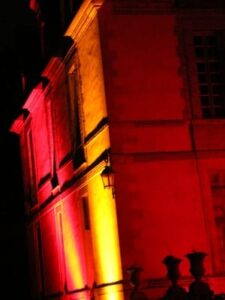
Nestled in the heart of the Yvelines, Château de Thoiry is far more than a Renaissance architectural gem: it is a place where time seems to slow down and civilizations come together.
Its exceptional architecture, designed in the 16th century by Philibert de l’Orme according to precise astronomical principles, seems almost destined to become a crossroads of cultures. The château’s perfect alignment with the sun at the equinoxes already hints at this openness to the wider world.
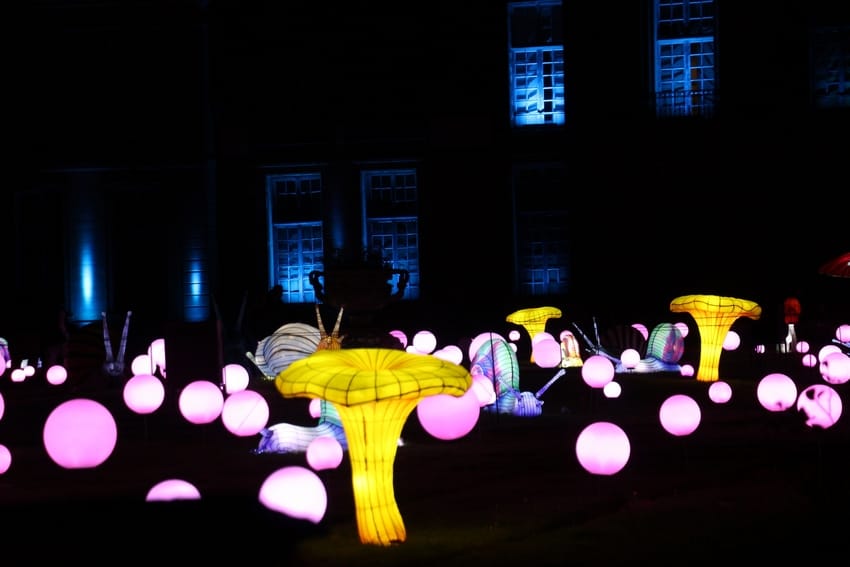
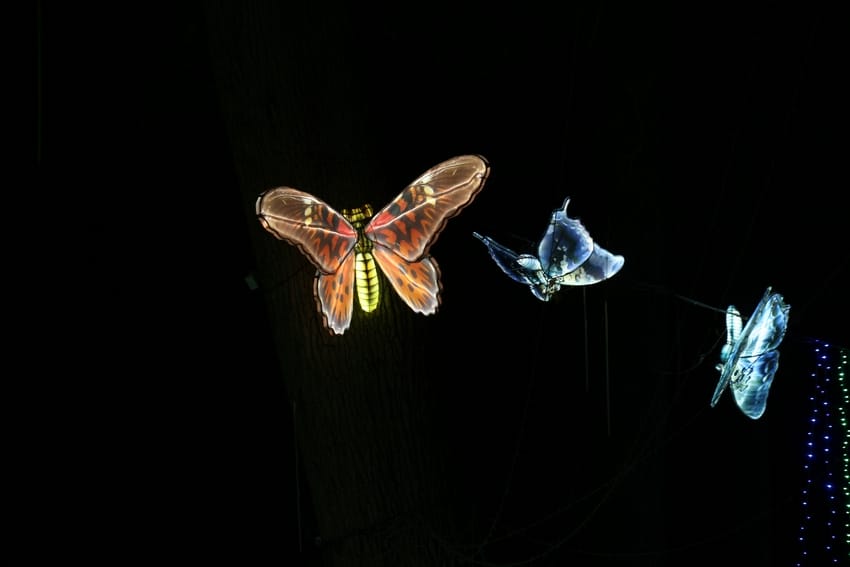
Each winter, the Thoiry Lumières Sauvages festival fully expresses this spirit. Hundreds of handcrafted Chinese lanterns, ephemeral works of art, transform the park into a magical landscape where a poetic dialogue unfolds between East and West.
Visionary in his approach, Count Paul de La Panouse transformed his family’s estate into a unique cultural odyssey where a wildlife reserve, architectural heritage and artistic exploration coexist in harmony.
Today, as he prepares a new book exploring the universal connections between civilizations through their monuments, the Count welcomes us to discuss his enduring quest for greater understanding between peoples.
Between its history-laden stone walls and the lanterns illuminating the winter landscape, Château de Thoiry continues, season after season, to write one of the most beautiful chapters in the story of civilizations living and learning together.
Exclusive Interview with
Paul de La Panouse
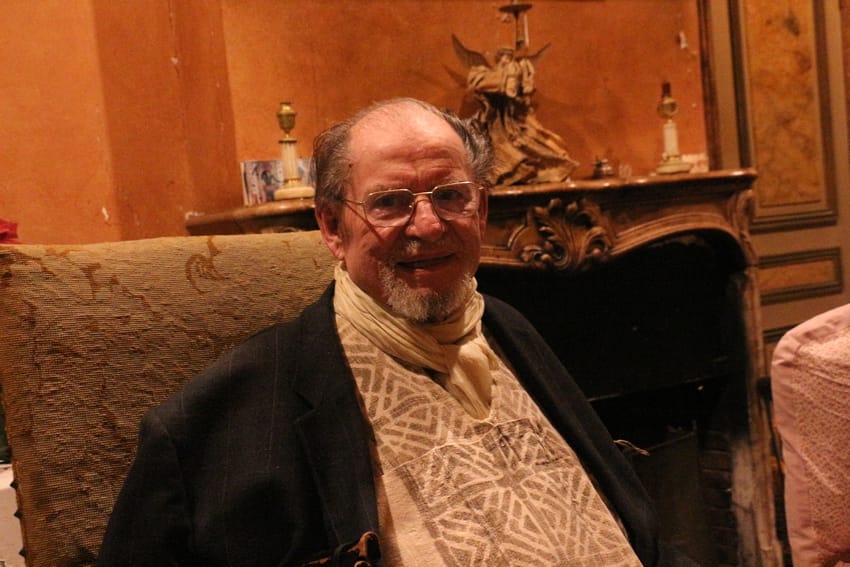
The connection between Château de Thoiry and China goes back much further than we might imagine?
Absolutely. Many visitors are unaware that our connection with China dates back much further than recent history. Its roots go all the way back to the 18th century, as demonstrated by an extraordinary document that we carefully preserve in our archives: an 800-page confidential report commissioned by the Finance Minister of Louis XV. The document provides remarkably detailed information about the activities of trading companies engaged in commerce with China under the Ancien Régime.
Has this Franco-Chinese influence left visible traces on the estate?
In many ways!
Inside the château, the connection is tangible. We have a valuable collection of Chinese porcelain, and, above all, a unique piece of original Chinese wallpaper, unlike anything else in France. Its importance is such that it was designated a Monument Historique at the request of the French state itself.
Look at our gardens: the geometric rigor of the formal French gardens gradually gave way to Anglo-Chinese gardens, which were very fashionable during the Enlightenment and drew directly on Asian landscape aesthetics. This was a profound transformation, reflecting the influence of Chinese culture on our heritage.
And has this relationship continued into modern times?
Our guest book bears the historic signature of Qiao Guanhua, China’s Foreign Minister, who visited us in 1975. Visits by Chinese ambassadors in 1982 and 1987 subsequently strengthened these diplomatic ties, ushering in an era of sustained cultural exchange.
Even today, this transcontinental connection remains very much alive. It is nourished by continuous cultural exchanges and manifests itself in the most tangible way possible: across the vast expanses of our wildlife park, where numerous species originating from China and Asia roam freely. These animals are living ambassadors of this long and rich history of mutual fascination between Thoiry and the East.
How did your first encounter with the Chinese world come about?
In a completely unexpected way! My first direct contacts came about through a very indirect situation. It was around 1970. A Viet Cong delegation was in France to negotiate peace in Vietnam, and it was being advised by Chinese diplomats.
One day, I received a phone call from the Vietnamese delegation asking me, “We would like to come and visit Thoiry. How much does it cost?” I immediately replied, “It costs nothing. You are my guests.”
So they came, and apparently they enjoyed the visit. They told their Chinese advisers, “Thoiry is very good.” On the strength of that recommendation, the Chinese delegation contacted me to arrange a visit of their own. That is how it all began. We had the pleasure and honor of welcoming many Chinese delegations to Thoiry.
A friendly relationship developed. We then multiplied our cultural projects: exhibitions, hosting the famous Peking Circus, and many other initiatives. We did a great deal here at Thoiry.
The collaboration was so warmly appreciated that in 1982, as a gesture of thanks, my wife Annabelle and I were invited to China. I gave lectures there, and we had the opportunity to discover the splendor of Chinese gardens, which absolutely fascinated me.
Did this encounter with Chinese culture influence the way you look at your own heritage, including the architecture of Château de Thoiry?
Absolutely. It opened my eyes to universal principles. We often talk about Feng Shui, but take the architecture itself—the architecture of Thoiry. It is governed by harmonious proportions and by the golden ratio.
And did you know that the golden ratio, this divine proportion, can also be found in Chinese summer palaces, in the proportions of their courtyards and buildings? It is something truly universal.
That is precisely the subject of the book I am currently writing: monuments oriented according to the path of the sun across the sky and proportioned according to sacred geometry and the golden ratio.
Geometry as a common language?
Exactly! Geometry makes it possible to solve complex equations with remarkable simplicity, in a way that can even be understood by a worker. Take the demonstration of the Pythagorean theorem using a rope with 13 knots: you form a 3-4-5 triangle, and there you have it. The classical Greek demonstration, with its 25 small squares on the hypotenuse corresponding to the 16 and 9 on the other sides—9 + 16 = 25—is very elegant.
And what about the Chinese?
Ah, this is where it gets fascinating! There is a Chinese triangle documented in a mathematical text dating back to around 1000 BC. Their demonstration is somewhat different and, dare I say, more subtle than the Greek one. They place a small square in the middle, which makes the surface area immediately apparent. It is remarkably ingenious.
And the most striking thing? It predates the Greek demonstration. These are exactly the kinds of things I love: universal truths discovered independently, creating a dialogue across centuries and cultures. And unfortunately, almost no one knows about them.
You often talk about the relationship between architecture and the sacred. Could you explain that connection?
Every form of monument corresponds to a liturgy. We have lost that understanding, but it existed. Across civilizations, all liturgies were based on sacrifice—including Christianity, with the Mass and the sacrifice of Christ. A cathedral is literally built according to the structure of the Mass. Today, even priests themselves have forgotten the symbolism behind their gestures.
And this universality strikes you?
It is fascinating! We find the same fundamental myths everywhere. The square represents the earth, the dome represents the sky… But what is truly fascinating is that monuments only appear with the development of agriculture. Whether it is rice in China, maize in the Americas or wheat in the Middle East, the phenomenon is universal.
As long as human beings were nomadic hunter-gatherers, there were no monuments. As soon as people settled into villages, dolmens appeared.
Take the Gavrinis dolmen in France. Most French people do not know it, but it is 6,000 years old! Its passage is oriented so that at the winter solstice, the sun illuminates half of the burial chamber. And every 18.6 years, when the Moon reaches its maximum declination, the other half is illuminated. It dates back 2,000 years before the Great Pyramid of Khufu!
And does the scale of monuments evolve with society?
Exactly! Near Gavrinis, the Locmariaquer menhir weighs 320 tonnes. It was transported over a distance of 10 kilometers by villagers using no apparent advanced technology.
When societies develop into cities of between 10,000 and 80,000 inhabitants, we see temples appear—Greek or Mayan—with the same proportions. Beyond one million inhabitants, we enter the age of empires, with the pyramids of Egypt, Angkor in Cambodia, Borobudur in Indonesia…
Each time, human beings push beyond their apparent limits. We still do not know exactly how the pyramids were built! People repeatedly went beyond what seemed to be their physical and technical capabilities in order to create monuments that made it possible to perform liturgies, to tame natural and spiritual forces, and to accompany the soul towards eternity.
But these rituals have disappeared…
Yes, because most of them were secret and passed down orally. Materialist archaeologists are not particularly comfortable with this idea. Yet ritual predates monuments! It emerged alongside art, some 40,000 years ago. Just look at Chauvet and Lascaux. And the oldest known cave painting is not actually in France, but in Indonesia.
Do you see this as a form of convergent evolution?
Exactly! Just as in biology: the ostrich in Africa, the rhea in South America, the emu in Oceania—distant relatives that developed similar adaptations. Culturally, the same thing happens. Monuments respond to the same fundamental needs, rooted in the idea of sacrifice.
Why do human beings die as heroes, as soldiers, or get killed as criminals? Humanity is constantly moving between these two poles. This fascinating convergence is what my book will explore.
How could ancient civilizations master such advanced mathematical concepts without our modern algebra?
Our ancestors developed a brilliant way of dealing with irrational numbers before they had been formally defined. Take the diagonal of a square, √2, which is approximately 1.414, or π for the circle, 3.1416… And of course there is the golden ratio, φ, which is 1.618.
They could not manipulate these numbers algebraically, but they could work with them through geometry.
By working with fundamental geometric shapes, they were able to reproduce all these proportions. And they were exceptionally skilled at it. It was not until the Renaissance that irrational numbers really began to be formalized. In the context of human history, that is actually very recent.
Yet everywhere we find the same principle: one gives rise to two, which becomes three, much like yin and yang.
This duality seems to run through all philosophies…
Look at this valley: one side is in shadow, the other in sunlight, and between them the river flows. That is where true philosophy lies!
This trinity can be found everywhere: in ancient Egypt with Osiris, Isis and their son Horus; in Christianity with the Trinity… It is the idea that two beings united by transcendent love give rise to a third through their relationship itself. It is a remarkably modern concept!
Does modern science converge with this vision?
Absolutely! Quantum physics confronts us with the Planck scale, with those unimaginably tiny fractions of time immediately after the Big Bang that challenge our understanding. And when we finally unlock that mystery, a new horizon will open up.
Human beings are made this way. Our ancestors left Africa and ventured into the unknown, crossing oceans without knowing whether they would find land on the other side. This thirst for new horizons is part of what defines us.
And today, does artificial intelligence represent our new horizon?
It is fascinating! In my day, a simple search in a library could take half a day. Today, AI gives us access within thirty seconds to an unimaginable amount of knowledge.
But we have to be careful: I have already spotted mistakes in it. Paradoxically, to use AI properly, we need a strong general and historical education more than ever.
It is a wonderful tool, but one that requires a sharp and well-trained critical mind.
Interview: Wendy
Rédaction: Hervé
Assistant : Charles
Proposition de lecture:
https://airsdeparis.com/ecologie/portrait-colomba-de-la-panouse/
https://airsdeparis.com/balade/thoiry-lumieres-sauvages-2025/
Magazine digital: 2025 – Automne

https://airsdeparis.com/publication/airs-de-paris-2025-summer/
Magazine digital – Fashion 2025

https://airsdeparis.com/publication/fashion-2025/
Magazine imprimé

https://www.journaux.fr/airs-de-paris_mode-beaute_feminin_280044.html
Abonnement dans le monde
