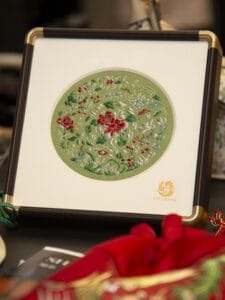
At the heart of Chengdu, brocade is far more than a textile.
It carries the memory of a city deeply rooted in the culture of silk and reflects a distinctive Chinese aesthetic, where colour, pattern, material and craftsmanship come together to form a language of their own.
Yet, for younger generations, Chengdu brocade is sometimes still associated primarily with cultural heritage: precious, traditional and almost museum-like, but seemingly distant from contemporary lifestyles and everyday aspirations.
It is precisely this distance that SHUCHARM seeks to bridge.
A brand of Sichuan Tianyun Jincheng Arts & Crafts Co., Ltd., SHUCHARM places Chengdu brocade at the heart of its identity, reinterpreting it through bags, accessories, creative objects, made-to-measure qipao and collections crafted from mulberry silk.
But the approach goes far beyond simply reinterpreting traditional motifs.
The brand chooses to return to the essence of the craft itself: mulberry silk, degumming and dyeing, as well as shuttle-loom weaving. Its ambition is to preserve what makes Chengdu brocade unique — its subtle layers of colour, natural sheen, distinctive relief and tactile quality — while giving it new uses through contemporary design.
Originally from Chengdu, Song Bin, General Manager of SHUCHARM, embraces this vision with a simple conviction: passing on a tradition cannot mean simply preserving the past. It must allow that tradition to continue to live.
For her, preserving craftsmanship therefore means more than safeguarding an old piece or reproducing a historical pattern. It also means creating the conditions for heritage to continue to be used, appreciated, desired and reinterpreted by present-day generations.
A conversation with
Song Bin

Why did you choose Chengdu to create a brand centered on Chengdu brocade? What was your original intention?
I am originally from Chengdu myself. We chose to establish SHUCHARM here because Chengdu brocade is naturally part of the city’s cultural heritage. It also represents a particularly important expression of China’s silk culture.
When we created SHUCHARM, our initial intention was not simply to build a brand using symbols from traditional culture.
Rather, we noticed that many people had already heard of this textile, but did not necessarily understand what truly defines it: its colors, texture, luster, and tactile qualities.
At the heart of SHUCHARM is what we call “蜀地炫彩” — the vibrant colors of Sichuan.
We want to return to the craftsmanship itself: preserving the subtle color variations created through dyeing, the natural luster of mulberry silk, and the texture produced by shuttle weaving.
From these materials and techniques, we then want to create contemporary products that can bring Chengdu brocade into everyday life.
What, in your view, makes Chengdu brocade particularly unique and worth discovering by younger generations?
In my view, what makes Chengdu brocade unique is not only its history, nor even its traditional patterns.
Above all, it is the richness of its colors and its distinctive three-dimensional textile texture.
These qualities result from a complex interaction between yarn preparation, dyeing ratios, the structure of the warp and weft, and shuttle weaving.
Simply changing a pattern or choosing another fabric is therefore not enough to reproduce the same result.
The best way to discover Chengdu brocade today is to look at it, but above all, to touch it.
By observing the depth and softness of its colors, the luster of the mulberry silk, and the texture of the fabric, people can truly appreciate how different it is from ordinary industrial textiles.
Chengdu brocade has a distinctive presence.
You need to see it under the light, but you also need to hold it in your hands to fully understand its richness.
What does the production and craftsmanship system developed by the Chengdu Brocade Factory in the 1980s mean to SHUCHARM today? Which techniques are essential to preserve?
This production system is one of the essential foundations of SHUCHARM’s heritage.
What we seek to preserve is not simply an old pattern, but an entire production philosophy, together with a body of standards and accumulated experience — from yarn preparation and degumming to dyeing and weaving control.
For weaving, we continue to use shuttle looms.
The way these looms operate and the tension control they provide are essential for achieving the characteristic relief and density of Chengdu brocade.
Modern rapier looms can naturally improve production efficiency considerably. However, given our current requirements for texture, they have difficulty reproducing exactly the same result.
We must also preserve the degumming and dyeing formulas passed down over time, as well as the sequence of operations and color control.
I would say that the shuttle loom preserves the texture of Chengdu brocade, while degumming and dyeing preserve its nuances and luster.
Together, these two dimensions form the distinctive craftsmanship of SHUCHARM.
From the preparation and dyeing of mulberry silk to weaving and the manufacture of the finished product, which stage requires the most experience?
If I had to choose one stage, I would say that degumming and dyeing require particularly extensive experience.
A slight variation in the proportions, processing time, or condition of the yarn can alter the depth, softness, and nuances of the final color.
But the real difficulty in producing Chengdu brocade lies in coordinating dyeing with the weaving process that follows.
The dyed yarns must then withstand the tension and structural requirements of the shuttle loom.
A problem that occurs at an earlier stage may only become visible once the fabric has been woven, when it is already extremely difficult, or even impossible, to correct.
This work therefore cannot be carried out solely according to standardized parameters.
It also requires years of hands-on experience, a keen eye for observation, and an intimate understanding of the material.
It is this accumulated experience that makes it possible to understand what the fabric “requires” at each stage.
How can we help younger generations truly discover and appreciate Chengdu brocade, rather than seeing it merely as an element of historical heritage?
I do not think we should begin by talking to them only about history.
We first need to give them the opportunity to see, touch, and use Chengdu brocade.
That is why we develop bags, accessories, and other everyday products, allowing younger people to first discover the beauty of the colors and the textile’s distinctive relief texture.
Only then can they become interested in the degumming, dyeing, shuttle weaving, and the craftsmanship passed down behind the finished product.
We also hope to develop workshop visits, weaving experiences, and collaborations with designers.
The aim is to show the complete journey of the textile — from a simple silk thread to the finished product.
A traditional technique can truly remain alive only when it connects with the personal aesthetics and everyday lives of younger generations.
Otherwise, it risks becoming merely a historical symbol preserved in museums.
Why did you choose bags as one of the main ways to bring Chengdu brocade into contemporary life?
Because a bag combines everyday use, functionality, and aesthetic expression.
Historically, Chengdu brocade was more commonly found in ceremonial garments, display pieces, or collectible objects.
A bag, by contrast, can be carried, used repeatedly, and taken anywhere.
It also provides a natural way to showcase the colors and texture of the textile.
In this way, Chengdu brocade moves from being a cultural symbol viewed from a distance to becoming an object that people can actually own, wear, and use.
At the same time, bags impose very practical requirements on the textile: resistance to wear, structural stability, manufacturing precision, and finishing quality.
This also requires us to study Chengdu brocade from a product-engineering perspective.
We do not want the textile to simply be placed on the surface of a product as a decorative element.
We want it to genuinely contribute to the product’s structure, functionality, and overall design.
At a time when industrial production is becoming increasingly efficient, why retain an element of craftsmanship?
We do not believe that every stage necessarily needs to be done by hand.
Nor do we believe that a handmade product automatically has greater value.
Industrial production can improve efficiency and consistency.
Hand craftsmanship is particularly relevant when certain stages require decisions to be made according to the material itself.
Chengdu brocade has very distinctive patterns and textures.
For certain products, the placement of the fabric, pattern matching, cutting, shaping, and finishing details need to be adjusted according to each individual piece.
It is difficult to replace these decisions entirely with a standardized production line.
The value of hand craftsmanship therefore does not simply lie in the fact that it is slower.
It lies in the observation, judgment, and control exercised by the craftsperson at every stage.
This allows us to better preserve the patterns, texture, and details of the textile, while contributing to the quality and uniqueness of certain products.
Why continue to prioritize natural mulberry silk and use an acid-dye system based on plant-derived raw materials? What technical and economic challenges does this involve?
We chose natural mulberry silk because its soft luster, tactile qualities, and ability to absorb color are fundamental to the quality of Chengdu brocade.
Other fibers can produce a similar visual effect, but it is difficult to fully reproduce the distinctive luster and color nuances of natural mulberry silk.
For dyeing, SHUCHARM uses an acid-dye system suitable for silk and incorporating plant-derived raw materials.
When we refer to a “plant-based” system, we are referring to the origin of certain raw materials used in the dye formulation.
The term “acid dye” refers to the dyeing mechanism itself.
The two concepts are therefore not contradictory.
Nor is this the same as traditional plant dyeing obtained directly by boiling plants.
This system must provide good fixation on silk while delivering the nuances, depth, and luster that we seek at SHUCHARM.
It must also provide sufficient colorfastness for everyday use, particularly for bags.
Our goal is therefore to increase the proportion of plant-derived raw materials as much as possible while maintaining quality and performance, and reducing our dependence on dyes made entirely from petrochemical-based raw materials.
Naturally, this creates both technical and economic challenges.
Natural mulberry silk is relatively expensive.
Plant-derived raw materials can also vary from one batch to another.
Degumming, color formulation, and dyeing therefore require extensive testing and adjustment.
But these investments directly determine the luster, colors, and tactile qualities of Chengdu brocade.
They are therefore standards that we do not want to compromise easily.
SHUCHARM also uses microfiber synthetic leather and vegetable-tanned leather for certain products. How do you approach the relationship between material choices and environmental responsibility?
With these materials, our goal is to find a more appropriate balance between product performance, service life, and environmental impact.
Compared with traditionally chrome-tanned leather, each of these materials can offer certain environmental advantages in specific circumstances.
However, we do not automatically consider either of them to be an “eco-friendly material.”
The first advantage of microfiber synthetic leather is that it does not directly require animal hides, thereby reducing dependence on the supply of raw hides.
In addition, microfiber materials generally have more consistent thickness, dimensions, and surface conditions.
This can improve cutting efficiency and reduce certain losses associated with defects or irregular shapes found in natural hides.
Finally, high-quality microfiber materials can offer good abrasion resistance, durability, ease of maintenance, and performance stability.
They can therefore contribute to extending the actual service life of a product.
As for vegetable-tanned leather, its main advantage compared with conventional chrome tanning is that it does not use chromium salts as the primary tanning agent.
This can help reduce certain risks associated with wastewater management and waste containing heavy metals.
The tannins used in vegetable tanning can come from bark, wood, fruit, and other plant sources.
This origin can also contribute to improved traceability of raw materials.
Vegetable-tanned leather also develops a natural patina over time and can be maintained and repaired.
Extending its lifespan through proper care is itself one way of reducing resource waste.
For SHUCHARM, therefore, the principle is not to demonstrate that a material is environmentally friendly simply by referring to its name.
We want to select materials according to the structure and intended use of each product, while also considering the transparency of their origin, cutting efficiency, durability, repairability, and ultimately their service life.
From material selection and dyeing to weaving and finished-product manufacturing, what are the main environmental issues SHUCHARM is currently focusing on?
We are currently focusing on four main areas.
The first is transparency regarding the origin and composition of materials.
This includes the origin of natural mulberry silk, the proportion of plant-derived materials in the acid dyes we use, as well as the production methods for microfiber synthetic leather and vegetable-tanned leather.
We hope to gradually obtain more information from our suppliers, including technical documentation, test reports, and material composition data.
The second area concerns dyeing and production processes.
While ensuring nuanced colors and sufficient colorfastness, we seek to optimize the use of dyes, water, and various production processes in order to reduce unnecessary consumption and reprocessing.
The third concerns material utilization.
The relatively consistent dimensions of microfiber materials and vegetable-tanned leather can improve cutting efficiency.
For Chengdu brocade, we seek to reduce waste through better cutting optimization, small-batch production, and the reuse of offcuts.
Finally, the fourth area concerns product lifespan.
Shuttle weaving provides a stable textile structure.
We also seek to select Chengdu brocade, microfiber, or vegetable-tanned leather appropriately for different parts of each product in order to improve its durability in everyday use.
In the future, we also hope to gradually develop maintenance and repair services so that our products can be used for as long as possible.
For SHUCHARM, sustainability is not a label that has already been achieved.
It is an ongoing process that must be continuously improved.
We want our environmental commitments to be based on real materials, verifiable supply-chain information, and the actual lifespan of our products, rather than simply on concepts.
Why do you believe now is the right time to bring Chengdu brocade to international markets?
International markets are increasingly interested in products with genuine cultural origins, distinctive materials and craftsmanship, and a clearly defined brand story.
This creates new opportunities for Chengdu brocade.
At the same time, we have begun transforming the textile from something primarily cultural or intended for display into a contemporary and functional product, particularly through bags.
Through our participation in “Rong Shang Paris · Connecting with the World” (蓉尚巴黎·链动全球), we want international consumers to discover more than simply a traditional Chinese pattern.
We want them to discover natural mulberry silk, nuanced colors, the texture created by shuttle weaving, and the craftsmanship behind the product.
But internationalization cannot rely solely on a cultural story.
Product design, quality standards, pricing, distribution channels, and the ability to adapt our communication to different markets are equally important.
For us, this is both an opportunity for Chengdu brocade to be tested by the international market and an important learning stage: understanding how to communicate with consumers from different cultural backgrounds.
If you were to collaborate with international designers, brands, or artistic institutions, what kind of cross-cultural encounter would you hope to create?
We do not simply want to add the name of an international designer to an existing product.
Nor do we want to superficially juxtapose European design with traditional Chinese patterns.
We want Chengdu brocade to participate in international creative work as a craft and material in its own right.
SHUCHARM can bring natural mulberry silk, nuanced colors, the texture of shuttle weaving, and traditional weaving expertise.
Our international partners, in turn, can bring new structures, new uses, and new ways of telling the story of a product.
Together, we can start from the material and the craftsmanship to develop genuinely new products or works of art.
We also want these collaborations to respect the origins of the craftsmanship and intellectual property.
Our ambition is for international audiences not to see Chengdu brocade merely as an exotic Oriental symbol viewed with curiosity.
We want it to be recognized as a textile language capable of participating in contemporary design and engaging in an equal dialogue with other cultures.
If you had to introduce SHUCHARM to the world in a single sentence, what would you say?
“SHUCHARM takes the original texture of Chengdu brocade inherited from tradition and weaves the vibrant colors of Sichuan, allowing the world to discover the luminous beauty of Chinese silk.”
Ultimately, this sentence summarizes our vision.
We want to preserve a material, a gesture, and a memory, while giving them new uses and new audiences.
From Chengdu to the international stage, Chengdu brocade is not meant to remain frozen in the past.
It can continue to evolve, to be worn, touched, used, and reinterpreted.
A tradition truly remains alive only when it continues to inspire desire in the present.
And perhaps this is the true mission of SHUCHARM: not merely to preserve the heritage of Chengdu brocade, but to give it the means to write its next chapter.

Rédaction|编辑|Editorial:Hervé
Assistants|助理|Assistants : Yann , Camille , Inès
Français|法语|French :
https://www.airsdeparis.fr/design/interview-song-bin/
Chinois|中文|Chinese :
https://airsdeparis.org/design/interview-song-bin/
Anglais|英语|English :
https://airsdeparis.com/design/interview-song-bin/
Magazine digital|数字杂志|Digital Magazine
Airs de Paris : 2026 Autumn & winter :
https://airsdeparis.org/a-la-une/airs-de-paris-2026-autumn-winter/

Fashion 2026 – Autumn & winter :
https://airsdeparis.org/publication/airs-de-paris-fashion-2026-autumn-winter/

Kiosque|杂志亭|Newsstand
Édition papier |纸质版 |Print Edition
https://www.journaux.fr/produits/presse/F%C3%A9minin-6/Airs-de-Paris-280044

Abonnement|订阅|Subscription
https://www.uni-presse.fr/abonnement/abonnement-magazine-airs-de-paris/
