Within Première Vision Paris, the “Textiles of France” pavilion, presented by the Union of Textile Industries (UIT) and its network, brings together a selection of materials and creations from French companies.
The space showcases several facets of the French textile industry, from expertise developed over several generations to technical materials and new fibres intended for the fashion, sports and performance sectors.
Laces and silks, fancy tweeds, jacquards featuring iconic patterns, as well as technical textiles and innovative materials make up this collection. They illustrate the diversity of the products and professions represented within the French textile industry.

French textiles focused on l’innovation
Alongside heritage and premium textiles, technical and innovative materials are showcased: recycled, organic and eco-efficient textiles.
These innovations find applications in very different fields. They reflect a profound shift in the textile sector: today, materials must not only be aesthetically pleasing, but also meet criteria of performance, functionality and responsibility.
This complementarity between tradition and innovation, creativity and performance, expertise and research is one of the strengths of French textiles.
Anna Franquesa, a trends and foresight expert in the fashion and textile sectors, and representative of the French textile industry at Première Vision, has been supporting professionals for several years in analysing developments in materials, colours and expertise. She shares her perspective on the new fibres and research that are shaping French textiles today.

Could you tell us about the latest developments in Made in France fabrics?
Above all, it is about better understanding and exploring new materials of natural origin. This includes plant-based dyes, as well as new fibre blends.
Of course, we still find 100% merino wool, but also many compositions based on wool. The aim is to restore this fibre to its rightful place, but also, more broadly, to promote all natural fibres.
Thus, alongside 100% linen, new materials are the subject of research and experimentation, such as kapok, ramie, nettle and hemp. These fibres are attracting growing interest among French weavers, who are seeking to develop new applications and new combinations.
We are also looking at the performance of new generations of viscose, particularly EcoVero and Lyocell, which offer more responsible alternatives to traditional viscose.
The challenge, therefore, is to explore all these possibilities and gain a better understanding of how these different materials can be used, combined and developed to meet the challenges of tomorrow’s textiles, while promoting the expertise and innovation of the French textile industry.
Have recycled fibres now become a new trend among French weavers?
Yes, we have many new developments emerging around recycled fibres. These include recycled polyester, which is now widely used by our weavers, as well as recycled polyamide.
We also work with innovative fibres and materials derived from recycling processes, such as Ossiqual and New Life, notably made from recycled plastic bottles.
We are also developing blends incorporating recycled cotton and recycled polyester. The aim is in particular to improve the strength of recycled cotton by adding polyester, in order to obtain more resistant and durable fabrics.
These blends can be used in many applications. They can notably be found in our jacquards, where we incorporate recycled polyester into the warp to provide greater strength to the fabric.
The use of recycled fibres has therefore become a very important element. For many weavers, it is now tending to become an almost essential component of textile creation.

Made in France as a source of creativity
Guest designer at this edition of Première Vision Paris, Alexis Mabille takes a particularly close look at French craftsmanship. For the designer, the importance of Made in France lies in particular in the richness and diversity of the crafts that continue to inspire contemporary creation. Lace is an iconic example.

“Made in France is important, particularly because France has a very strong tradition of lace, especially Calais lace.
There are also very beautiful types of lace in other countries, each with its own specialities. But it is true that the range of different types of lace in France is very broad. We also have wonderful artisans who create truly beautiful pieces.
That is precisely what makes it interesting for us. We are necessarily a French brand, so we try to give maximum priority to French products and expertise. And because we work with partners who are geographically close to us, it also allows us to communicate easily with them and develop new products more easily.”
The potential for Chinese designers
A new generation of high-end Chinese designers and brands is emerging today, with the ambition of developing distinctive creative identities.
In this evolution, French textile expertise provides a point of reference, particularly in areas where technical mastery and the quality of materials play an important role in the creative process.
Lace, embroidery, silk, jacquard, exceptional fabrics and certain technical textiles are all examples of expertise developed over generations by French companies and workshops. For Chinese designers looking to develop high-end collections, this expertise can open up new possibilities, both in terms of the choice of materials and the creation of the pieces.

The interest, however, is not limited to the use of French materials or components. It can also take the form of collaborations and co-creation projects. A Chinese brand can bring its aesthetic universe, cultural references and knowledge of Asian markets, while a French manufacturer or workshop brings its technical expertise, knowledge of materials and manufacturing processes.
The development of a fabric, embroidery, lace or specific finish can thus become a joint effort. This relationship then goes beyond the simple supplier-client relationship to create an exchange around product development, textile research and creative choices.

For Chinese designers as well as French companies, this meeting can thus open up a space for dialogue between expertise, innovation and different creative cultures.
Made in France then becomes less a simple indication of origin than a set of skills and resources that can become part of new creative processes.

Interview: Wendy
Written by: Hervé
Assistants: Maria, Lisa
Magazine Digital
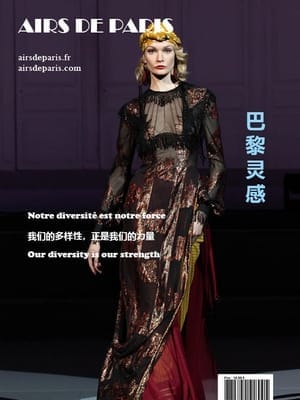
Airs de Paris : 2026 Autumn & winter :
https://airsdeparis.com/a-la-une/airs-de-paris-2026-autumn-winter/
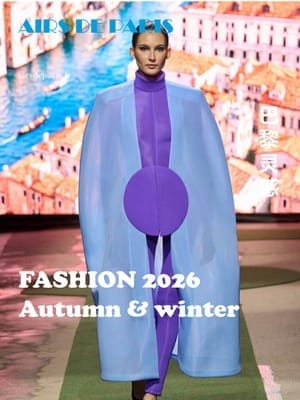
Fashion 2026 – Autumn & winter :
https://airsdeparis.com/publication/airs-de-paris-fashion-2026-autumn-winter/
Kiosque
Magazine imprimé:
https://www.journaux.fr/produits/presse/F%C3%A9minin-6/Airs-de-Paris-280044
Abonnement :
https://www.uni-presse.fr/abonnement/abonnement-magazine-airs-de-paris/