
Historian at Panthéon-Sorbonne University, Laurent Bihl explores, in his book Une histoire populaire des bistrots (A Popular History of French Bistros), far more than an ordinary everyday venue. Through an approach that combines history and visual culture, he reveals the bistro as a true observatory of French society.
A place for meeting, exchanging ideas and shaping representations, the bistro emerges in his work as a deeply vibrant space where social transformations and collective imaginaries take shape. His perspective feels particularly relevant today, as these emblematic places are changing or disappearing.
An Interview with
Laurent Bihl
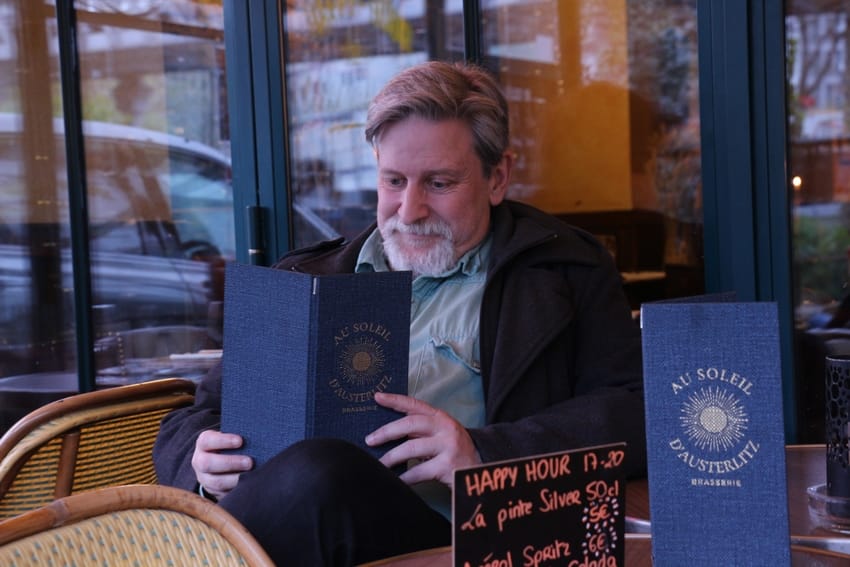
Why does the bistro occupy such a special place in French culture?
I am often asked about the specifically French nature of the bistro. First of all, it is worth remembering that the word bistrot did not appear until 1884. Before that, people spoke of cabarets, a term that had been used for several centuries.
That said, it would be an exaggeration to claim that the bistro is exclusively French. Similar forms can be found in Italy, and to some extent in Spain, although these countries are shaped by different cultural dynamics. What makes the French bistro distinctive is rather the combination of several factors. France is partly a Mediterranean country, deeply influenced by a Catholic tradition, and drinking establishments gradually developed into a kind of counter-power.
In France, the bistro became much more than simply a place where people consumed drinks. It established itself as a genuine media space. The importance of spoken word, traditions of protest and revolution, and the rise of the printed press created a close connection between the cabaret, the drinking establishment and the circulation of ideas.
Of course, places of social interaction exist in every culture. They can be found in the hutongs of Beijing, in British pubs, throughout Germanic and Slavic countries, or along ancient caravan routes in the form of caravanserais. But each of these places reflects a specific culture. Pubs, for example, are deeply connected to a Protestant culture, while other establishments respond to very different social and historical dynamics.
The French bistro stands out as a place of passage and encounter, heir to the cabaret tradition. It is part of a history shaped by the Enlightenment, the French Revolution and the development of the press. It thus became a privileged space for expressing and confronting ideas.
It was within this context that a specifically French tradition emerged: the bistro as a place of dissent. This dissent could be political, social, religious or anticlerical. The bistro became a space of freedom and transgression, where people could speak more freely and where established norms could be challenged. A certain degree of excess, sometimes associated with drunkenness, also became part of this culture of emancipation.
This reality should obviously not be romanticized. Alcohol, particularly during the nineteenth century, had serious public-health consequences. But it could also become part of a culture of transgression inherited from the eighteenth century, driven by strong anticlerical and secular currents.
Today, these conflicts largely belong to the past. But at the time, challenging the established order—and particularly the influence of the Church—could take many forms. The bistro became one of the most emblematic places where such dissent could be expressed.
What prompted you to write this book?
My father was a lawyer specializing in drinking establishments. In a sense, he was the lawyer of the bistros. In the early 1960s, following the reform of the legislation governing drinking establishments under the leadership of Michel Debré, he wrote the first legal book devoted to this new legislative framework.
At the same time, he was also an amateur historian. Towards the end of his life, when he was suffering from lung cancer, he wanted to write a history of bistros before he died. The disease progressed as quickly as the book. He wrote it under enormous pressure and in very difficult circumstances, which inevitably affected the quality of the text.
At the time, I was preparing my examinations to become a teacher, and he asked me to prepare notes for him. My writing was still rather clumsy, and he was already no longer able to read properly. He sometimes misinterpreted my notes, which contributed to the book’s imperfections.
Despite this, his book contained some very powerful ideas. It reflected all his experience and intuition, a lifetime of thinking about the subject, as well as the perspective of a lawyer enriching that of the historian. But the work remained unfinished. The book never really found its audience, and my father died shortly afterwards.
Thirty-five years later, following the COVID-19 crisis, my publisher was struck by a highly symbolic phenomenon. In people’s minds, the lockdown had begun with the closure of cafés at 11:59 p.m., notably around the Place de la Bastille, and it had ended with the reopening of outdoor terraces. The bistro thus appeared as a genuine barometer of freedom within society.
My publisher was looking for someone to write about the subject. I was a historian of caricature and the press, not of bistros. Yet when I heard about the project, I went to see him and told him that this book had to be mine.
So, thirty-five years later, I took up my father’s work. I wrote a book that is worth what it is worth, but which, in a sense, completes a work that had begun long before me. In doing so, I realized that this subject had remained within me all those years, like a story waiting to be taken up again and brought to completion.
How do you view the bistro?
First of all, as Pascal Ory, a member of the Académie française, points out in his foreword, the bistro is a place where words circulate freely. In that sense, it can be seen as one of the earliest forms of media: a medium based on the spoken word. It is a space for political discussion and sometimes heated debate, but also for private circles, gossip and rumor. It is where protests and demands can emerge, and sometimes even rebellions or demonstrations.
From the time of the French Revolution onwards, the bistro also became a place for intellectual reflection. Thinkers gathered there to exchange ideas inspired by the Enlightenment, particularly in the context of the creation of the Encyclopédie. During this period, people also went to cafés to keep up with and comment on political events, whether involving the political clubs, the sections or the Assembly.
These establishments were also places where the first popular newspapers were read aloud, particularly for those who could not read. Unlike newspapers aimed at the elites, which were often read privately, these collective readings made the bistro an essential space for the circulation of information. The street, being too noisy and unpredictable, did not always allow for such exchanges, which further strengthened the café’s central role as a place for transmitting information.
The bistro thus became a genuine media space, but also a cultural one. It was notably within this world that Guignol, the famous satirical and political puppet from Lyon, was born. More broadly, the bistro served as a bridge between different forms of entertainment. People would meet there before or after going to the theatre or cinema, extending the experience of the performance through conversation and discussion.
Finally, the bistro is also an ambivalent place, both a space of freedom and a space of surveillance. Police informers could mingle with customers, listening to conversations and reporting certain remarks. Under the influence of alcohol, careless words could lead to arrests. This reminds us that this space of expression, however free it might appear, was always part of a social and political framework in which control was never entirely absent.
Why are bistros disappearing?
The figures speak for themselves. In 1938, there were around 508,000 bistros in France. By the early 1960s, there were only 200,000. Today, barely 34,000 remain. This gradual disappearance raises questions about the profound transformations taking place within society.
In the past, the bistro fulfilled an essential need. Homes were often small, uncomfortable and sometimes poorly heated. People slept there, but spent relatively little time actually living there. The bistro therefore became an extension of the home. It provided warmth, both literally and figuratively, and above all a place for social interaction. People went there to talk, play, debate and share moments that were part of a deeply collective culture.
Today, living conditions have changed. Homes have become more comfortable and better equipped, making it easier to retreat into domestic life. At the same time, lifestyles have become increasingly individualistic. Leisure activities are more often pursued alone, frequently in front of screens. The bistro, as a place of spontaneous social gathering, has consequently been weakened.
Its disappearance therefore reflects a broader shift: the transition from a society based on collective life towards a society of individuals. This shift has consequences. Whereas people once had to confront problems associated with alcoholism, other issues are emerging today, such as social isolation and depression.
What is particularly striking is that bistros are disappearing at the very moment when they have arguably never been more peaceful or welcoming. Women have their rightful place there, violence is far less common, establishments are cleaner, and the range of offerings has become more diverse. People can consume differently, sometimes simply having a coffee or a glass of water. In other words, bistros have never been more pleasant, and yet they continue to disappear.
They are, in a sense, caught between two opposing forces. On the one hand, an increasingly individualistic society is reducing their social function. On the other, an image inherited from the past, sometimes a negative one, continues to weigh on them.
As is often the case, we tend to recognize the importance of these places only when they begin to disappear. The danger is that we may realize their value too late—when this form of social interaction has disappeared to such an extent that younger generations no longer know instinctively how to recreate it.
How do you see the evolution of bistros?
A bistro necessarily evolves with its times. Nothing would be more absurd than a bistro frozen in the past and turned into a museum. But adapting does not mean accepting everything. Should we, for example, encourage customers to consume constantly, or equip establishments with power outlets and Wi-Fi so that they become little more than extensions of the home?
This kind of evolution raises questions, because it can encourage a form of increasing individualization. Similarly, banning people from drinking at the counter, when there is one, or reducing it to a simple service area would mean denying an essential dimension of the bistro. The counter is a place of movement and interaction, and sometimes of encounter. It cannot be reduced to a purely functional purpose.
It is therefore important to distinguish between what represents a necessary adaptation to contemporary lifestyles and what amounts to a genuine distortion of the bistro’s identity. Once that line is crossed, the bistro risks losing its uniqueness and becoming a standardized, interchangeable place, disconnected from its cultural roots.
The danger is not only that of a standardized offering. It also concerns the very nature of the place. A bistro is not a neutral space where everyone remains isolated in their own bubble. On the contrary, it is a place people go to in order to share a physical presence, a conversation and a moment together.
Preserving this dimension is essential. Because ultimately, what makes the bistro so powerful is not simply what people consume there, but what they experience: a collective experience, simple yet deeply human.
What makes French cafés unique?
First of all, every drinking establishment abroad is deeply shaped by the culture of the country it belongs to. A Hungarian café does not resemble an Austrian one. In the same way, it is easy to distinguish a Portuguese café from a Spanish one, given how much their atmospheres, customs and forms of social interaction differ. Each place therefore has its own identity, shaped by its history and traditions.
In France, this distinctiveness takes on a particular dimension. Cafés and bistros are not simply places where people go to consume food and drink; they are genuine spaces of representation. They embody a certain idea of France and contribute to presenting it, particularly to foreign visitors. The bistro thus becomes a showcase for the French way of life—a place where the art of conversation, sharing and everyday life can be both seen and experienced.
That is why recognizing cafés and bistros as part of the intangible cultural heritage of France, particularly through UNESCO, seems increasingly important today. More than anywhere else, these places play a central role in preserving and transmitting a distinctly French way of life.
Is there a particular café that you especially like?
I go to many cafés, but I don’t believe there is such a thing as a perfect café. Some places, however, leave a stronger impression on me than others.
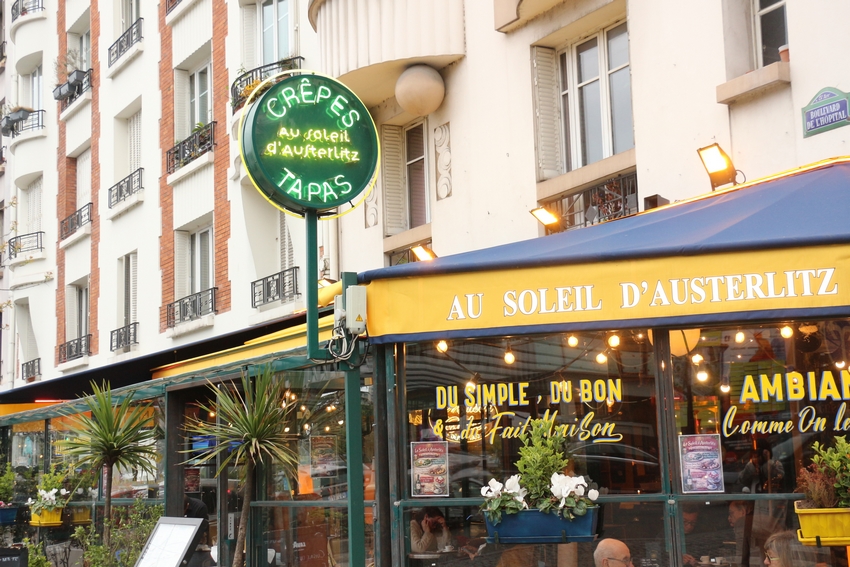
This one, for example, appeals to me because it has a genuine sense of identity. You can feel it in the way the place is organized, in the position of the counter, in the attitude of the servers, in the décor, and even in its relationship with the street. This identity is not accidental. It is the product of a history.
The establishment is run by an owner whose family comes from the Auvergne region. Behind the place lies several generations of know-how and tradition. Families such as the Salaberts belong to the tradition of the bougnats—people from Auvergne who originally sold coal and wine before moving into the café trade. Although there is nothing here that visually evokes Auvergne, that heritage can still be felt in the atmosphere, the efficiency of the service and a particular way of welcoming customers.
In the morning, this café mainly attracts workers, unlike some of the other establishments nearby. This shows just how much each café develops its own identity, shaped by its history, its location and its clientele.
Depending on the time and the place—whether you are near a railway station, in a Parisian neighborhood, in the suburbs or in the countryside—you are not looking for the same thing. There is therefore no universal ideal café, but rather a diversity of cafés suited to different uses and expectations.
Ultimately, perhaps that is what matters most. Just as with people, there is no single ideal. There are simply places that happen to suit us at a particular moment in our lives.
Interview : Wendy
Rédaction: Hervé
Magazine Digital
Airs de Paris : 2026 Spring

https://airsdeparis.com/publication/airs-de-paris-2026-spring/
FASHION : 2026 Spring & Summer

https://airsdeparis.com/publication/airs-de-paris-fashion-2026-spring-summer/
Magazine imprimé

https://www.journaux.fr/airs-de-paris_mode-beaute_feminin_280044.html
Abonnement dans le monde
