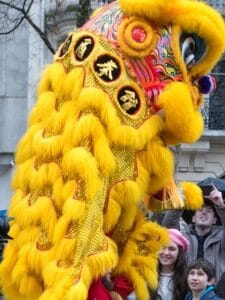
The Chinese New Year parade on the Champs-Élysées has now firmly established itself as a lasting fixture in Paris’s cultural landscape.
On the afternoon of February 1st, under a fine winter drizzle, the world’s most famous avenue was transformed into an open-air stage, animated by the festive momentum of the Chinese New Year. Within moments, Paris itself seemed to come alive.
With nearly 800 participants , a record since the event’s inception , this edition stood out for its scale and collective vitality. It revealed a contemporary vision of Chinese New Year: vibrant, inclusive, and decidedly oriented toward international dialogue and hybrid cultural forms.
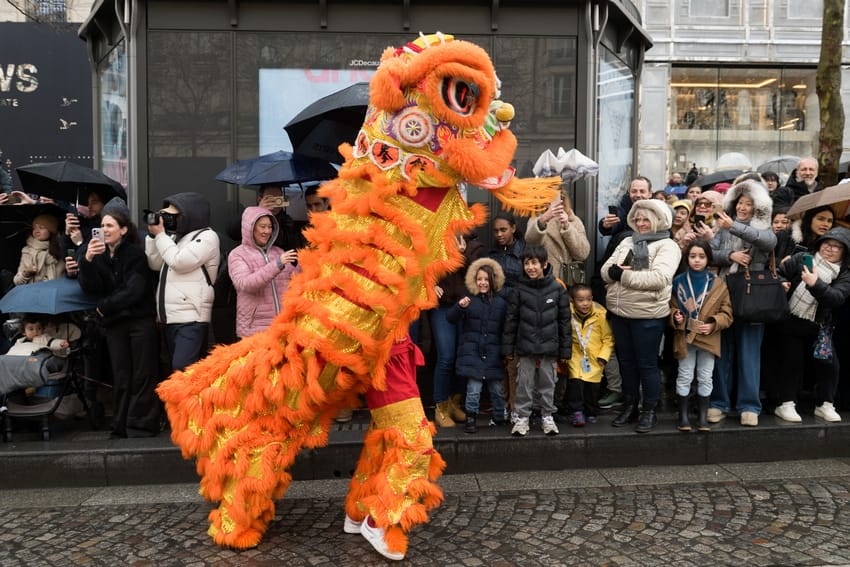
The parade’s first surprise appeared at the very front: a robot leading the procession.
Pivoting, pausing, and greeting the audience with gestures that felt almost human, its choreography, finely synchronized with the music, sparked both fascination and delight. Set against the historic backdrop of the Champs-Élysées, this futuristic presence created a striking visual contrast.
The Parade as a Living Artwork
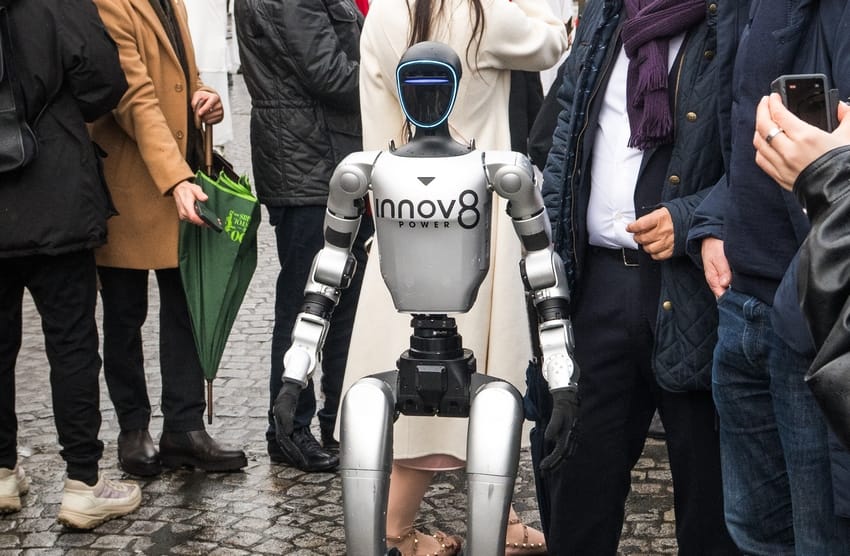
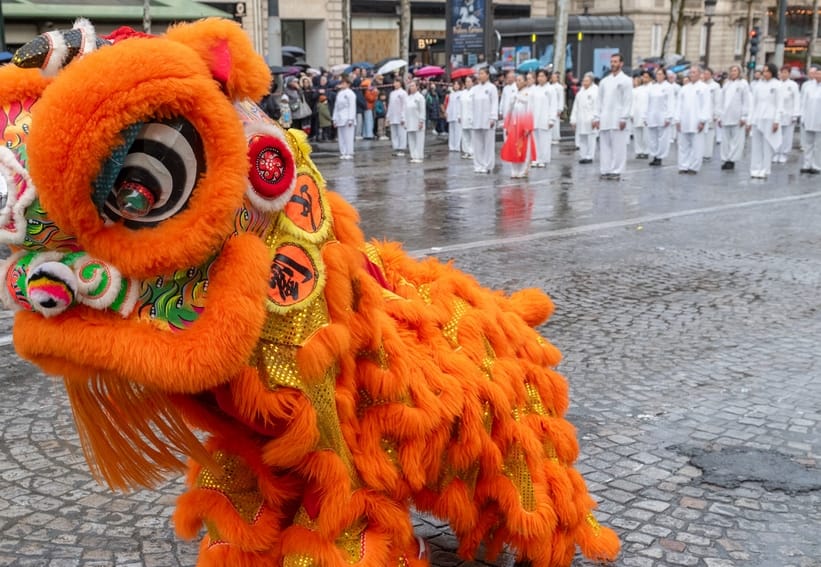
From the iconic Fouquet’s restaurant to the Arc de Triomphe, the procession unfolded like a moving installation. Dragon and lion dances traced fluid paths through the damp air, while silhouettes dressed in hanfu, with flowing cuts and delicate embroidery, evoked a sartorial heritage in which clothing becomes a language.
Powerful and grounded, Mongolian dances sent vibrations through the pavement. The Yangge of Northeast China infused the parade with a popular, colorful, almost jubilant energy. The richly textured and ornate costumes of the Miao dances reflected ancestral textile craftsmanship, executed with near haute couture precision.
At the heart of this visual and rhythmic abundance, tai chi and qigong demonstrations seemed to suspend time. Movement slowed, becoming meditation; gesture transformed into a form of silence.
Then came the Yingge dance , a martial and popular art form originating in Chaoshan , erupting with almost raw intensity. Dancers advanced with wooden hammers in hand, striking the ground with near-industrial rigor. The rhythm was sharp, repetitive, hypnotic.
Here, folklore shifted into contemporary performance. A radical, physical energy emerged, engaging naturally with the languages of live art and performative practice.
The Champs-Élysées thus became an open-air aesthetic laboratory, a space where cultures circulate, transform, and continually reinvent themselves.
A Distinctive Cultural Event in Paris
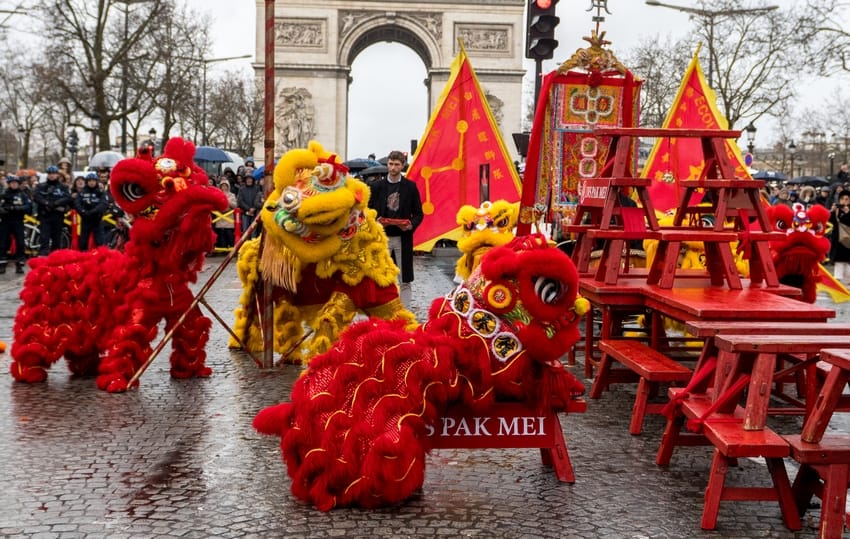
Since its first edition in 2022, the Chinese New Year parade has established itself as a distinctive annual event on the avenue.
Co-organized by the Champs-Élysées Committee and the National Tourist Office of China in Paris, the event is supported by Barrière Group , LWS Pak Mei , BORUI Agency , Codecom Agency , the ACDECF Association , and Altervip .
It is also supported by the Bank of China, the France-China Foundation, and the CCICF, as well as by the Embassy of the People’s Republic of China in France, the City of Paris, and the City Hall of the 8th arrondissement.
French Version :
https://www.airsdeparis.fr/cultures/le-nouvel-an-chinois-reinvente-les-champs-elysees/
Printed magazine

https://www.journaux.fr/airs-de-paris_mode-beaute_feminin_280044.html
Subscription worldwide

https://www.uni-presse.fr/abonnement/abonnement-magazine-airs-de-paris/